








What's Happening?
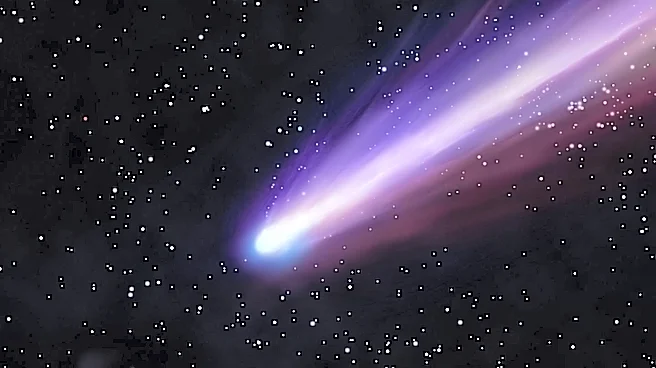
NASA is preparing to launch the Near-Earth Object (NEO) Surveyor mission, aimed at identifying and tracking near-Earth objects, including dark comets and asteroids that pose a risk to Earth. The mission will utilize infrared wavelengths to detect thermal
heat from these objects, which are often missed by ground-based telescopes due to their low reflectivity. This initiative follows the reclassification of 1998 SH2, previously thought to be an asteroid, as a dark comet. The reclassification was based on its unexpected deviation from its predicted orbit, attributed to outgassing, a phenomenon where gas escapes from a comet, altering its trajectory.
Why It's Important?
The NEO Surveyor mission is crucial for planetary defense, as it aims to improve the detection of potentially hazardous objects that traditional optical telescopes might miss. The discovery of dark comets like 1998 SH2 highlights the limitations of current gravity-only impact risk models, which do not account for non-gravitational forces such as outgassing. By enhancing the ability to detect these objects, the mission could significantly improve the accuracy of impact probability calculations, thereby safeguarding Earth from potential threats.
What's Next?
The NEO Surveyor mission is scheduled for launch no earlier than September 2027. It will be the first space-based infrared telescope specifically designed for planetary defense. The mission's success could lead to a reevaluation of the current catalog of near-Earth objects, identifying those that may have been misclassified due to undetected non-gravitational forces. This could prompt further research and development in the field of planetary defense.