





What's Happening?
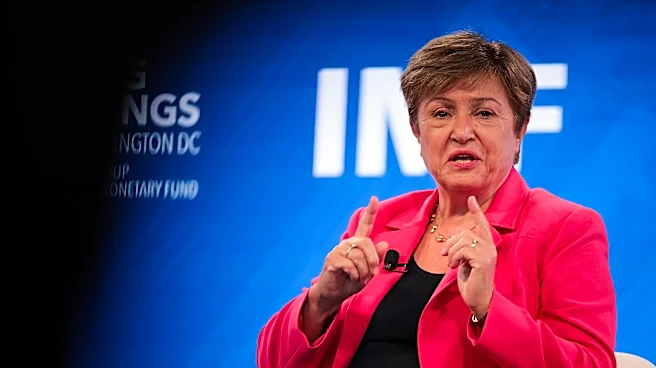
Sri Lankan President and Finance Minister Anura Kumara Dissanayake presented the government's third austerity budget to Parliament on November 12. This budget reaffirms the government's commitment to the International Monetary Fund's (IMF) requirements
for severe cuts and pro-business restructuring, a stance confirmed by Deputy Finance Minister Anil Jayantha Fernando after recent talks with an IMF delegation. President Dissanayake declared that Sri Lanka has achieved 'economic stability' and aims for a 'forward-looking and transformative era in 2027.' However, this stability has been achieved through austerity measures that have impacted millions. The budget allocates 4.85 trillion rupees (US$15.5 billion) for debt repayments, consuming nearly four-fifths of projected government revenue. Interest payments alone will absorb about 43 percent of revenue. The government also plans to introduce a Public-Private Partnership (PPP) Bill in early 2027 to advance privatization and restructuring of state-owned enterprises, with plans to close 34 such entities. The budget also includes cuts to the Aswesuma social welfare program, affecting nearly half a million poor people.
Why It's Important?
The Sri Lankan government's continued adherence to IMF-mandated austerity measures has significant implications for its population and economic structure. While the government claims economic stability, the policies are leading to the impoverishment of workers and the poor through increased costs of public services, job cuts, and stagnant real wages. The budget's focus on debt repayment and pro-business restructuring, including privatization, signals a long-term shift towards a market-driven economy that prioritizes international creditors and big business interests. This approach is praised by business entities like the Ceylon Chamber of Commerce and Joint Apparel Association Forum, which benefit from tax deductions and incentives. However, it exacerbates social inequality, as evidenced by a significant drop in real median household income between 2019 and 2025, while the wealthiest quintile saw an increase in wealth. The budget's neglect of general wage increases for public-sector employees and private-sector workers further highlights the uneven distribution of economic burdens and benefits.
What's Next?
The Sri Lankan government is set to continue its path of austerity and pro-corporate restructuring. With the current IMF program ending in March 2027, President Dissanayake has appointed a ministerial committee to explore entering a further IMF program, indicating a sustained commitment to these policies. The introduction of a Public-Private Partnership (PPP) Bill in early 2027 will likely accelerate the privatization of state-owned enterprises. The government's emphasis on increasing tax revenue through broader taxation and stricter collection, including mandatory Taxpayer Identification Number (TIN) registration for all adults, suggests further financial pressure on citizens. The budget's limited allocations for education and health, coupled with past underspending, suggest that social services will remain underfunded. Public discontent is already evident, with protests against the government emerging immediately after the budget announcement, indicating potential for continued social unrest as these policies are implemented.
Beyond the Headlines
The ongoing economic policies in Sri Lanka, driven by IMF dictates, reflect a broader global trend where developing nations grapple with debt and external financial conditionalities. The narrative of 'economic stability' presented by the government masks the severe social costs borne by the working class and the poor, raising ethical questions about the distribution of economic burdens during recovery. The government's prioritization of international creditors and big business interests over the welfare of its citizens could lead to long-term societal fragmentation and increased social unrest. The situation also highlights the political maneuvering of parties like the JVP/NPP, which campaigned against austerity but adopted it upon gaining power, underscoring the complex interplay between political promises and economic realities dictated by international financial institutions. This scenario could serve as a case study for the long-term impacts of austerity on national sovereignty and social cohesion.