
What's Happening?
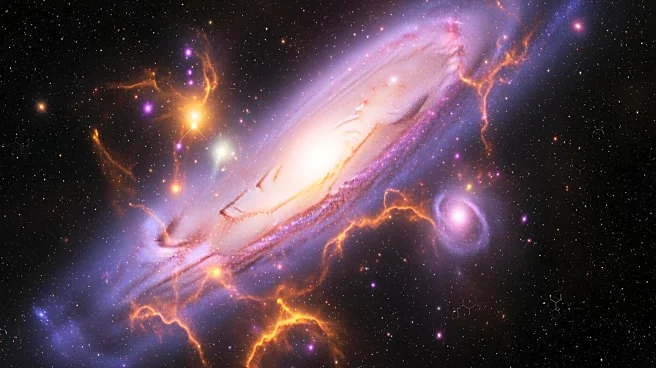
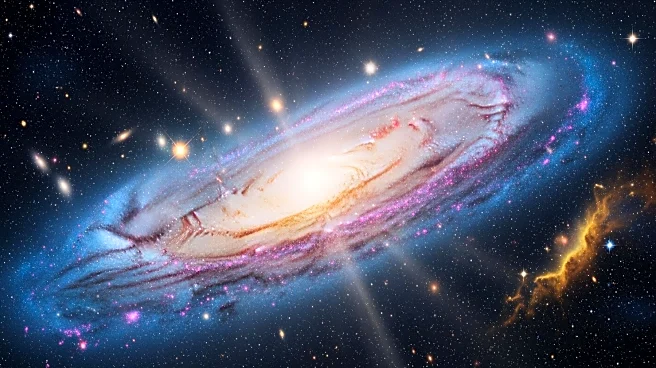
The James Webb Space Telescope (JWST) has revealed a massive galaxy, CEERS2-588, located just 400 million years after the Big Bang. This discovery, made by astronomers from the University of Tokyo and
other institutions, challenges existing models of early galaxy formation. CEERS2-588 is notable for its high mass and metal-rich composition, characteristics unexpected for galaxies at such an early stage. The galaxy's star formation rate is significantly higher than anticipated, suggesting that early galaxies experienced intense bursts of star formation. These findings provide new insights into the conditions that governed the formation of the first galaxies and the role of starbursts in early cosmic history.
Why It's Important?
The discovery of CEERS2-588 offers a new perspective on the formation and evolution of galaxies in the early universe. Its unexpected mass and rapid star formation rate challenge current theoretical models, indicating that early galaxy formation may have been more complex than previously thought. Understanding these processes is crucial for comprehending the universe's evolution and the development of cosmic structures. The findings also highlight the JWST's capabilities in exploring the early universe, paving the way for further discoveries that could reshape our understanding of galaxy formation and evolution.