


What's Happening?
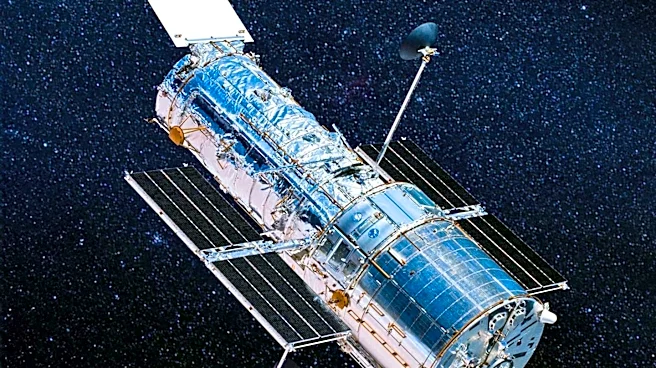
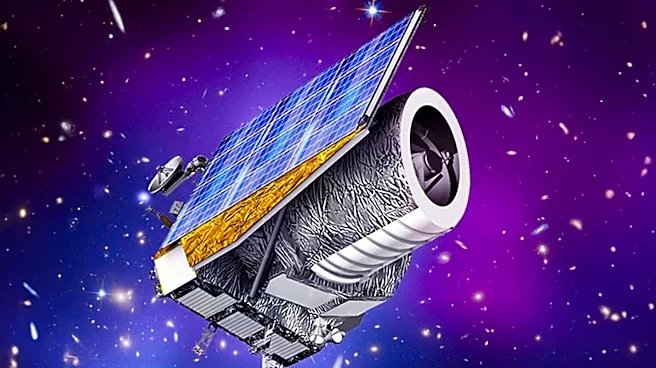
The European Space Agency's Euclid space telescope has released its first major data, leading to the discovery of 15,000 new potential strong gravitational lenses. This represents the largest collection of such cosmic 'magnifying glasses' to date, significantly
expanding the tools available for astronomers to investigate dark matter. The data release, comprising 1.7 million gigabytes, includes observations of over 900 million galaxies and 60 million quasars across nearly 5% of the night sky from 13 months of observation. Dr. Douglas Scott, a PHAS professor and member of the Euclid collaboration, noted that if Albert Einstein had access to Euclid's data, verifying his prediction of gravitational lenses would have been straightforward due to their abundance. Gravitational lensing occurs when light from a distant galaxy is bent by a foreground galaxy, revealing the composition and distribution of matter, including dark matter, in the foreground object.
Why It's Important?
This discovery is profoundly important for advancing our understanding of the universe, particularly regarding dark matter and dark energy, which constitute approximately 95% of the cosmos but remain largely mysterious. Gravitational lenses act as natural telescopes, magnifying distant galaxies and providing clearer images, which are crucial for studying the early universe and the distribution of matter within it. By identifying a record number of these lenses, scientists gain unprecedented opportunities to map the distribution of dark matter and investigate its properties. This data will also be used to study dark energy by comparing lens parameters with cosmological models. The ability to compare these newly discovered lenses, all observed by the same telescope and analyzed with consistent methods, offers a more reliable dataset than ever before, potentially leading to breakthroughs in fundamental physics and cosmology. The findings could reshape our understanding of how the universe expands and its ultimate fate.
What's Next?
Researchers, including doctoral student Hrishabh Srivastava, will now focus on utilizing this extensive catalog of gravitational lenses to estimate the dark matter distribution of the universe. Srivastava also aims to develop a machine-learning model capable of identifying strong lenses without human verification, which would significantly accelerate future discoveries. The data release, detailed in 26 papers submitted to the journal Astronomy & Astrophysics, also includes spectra from over 160 million sources, which will enable scientists to determine galaxy distances and construct a 3D map of the universe. Euclid is expected to survey about 14% of the total sky area during its six years of service, promising further discoveries. The next steps involve rigorous analysis of this vast dataset, which could lead to new theories or confirmations about the nature of dark matter and dark energy, ultimately refining our cosmological models.
Beyond the Headlines
The Euclid mission and its findings highlight the collaborative nature of modern scientific research, involving over 2,000 scientists globally. The use of machine learning to initially process vast amounts of data, followed by citizen scientists and expert verification, demonstrates an innovative approach to scientific discovery. This blend of advanced technology and human ingenuity is crucial for tackling complex cosmic mysteries. The mission also underscores the long-term investment required for space exploration and fundamental research, with Euclid costing over $1 billion. The quest to understand dark matter and dark energy is not just an academic pursuit; it addresses fundamental questions about the universe's origins, evolution, and destiny, pushing the boundaries of human knowledge and potentially leading to unforeseen technological advancements inspired by these cosmic phenomena.