
What's Happening?
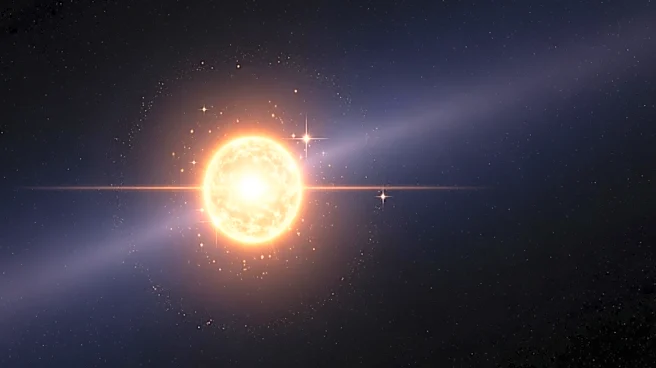
Astronomers have discovered SDSS J0715-7334, the most pristine star ever found, providing a unique glimpse into the early universe and the formation of stars and galaxies. This star, identified using data
from the Sloan Digital Sky Survey-V (SDSS-V) and observations from the Magellan telescopes at Carnegie Science’s Las Campanas Observatory in Chile, is noted for its exceptionally low metal content. It contains less than 0.005% of the metal content of our Sun, making it twice as metal-poor as the previous record holder. The discovery, published in Nature Astronomy, was led by Alexander Ji from the University of Chicago and Juna Kollmeier from Carnegie Observatories, with contributions from undergraduate students. This star is considered a relic from the early universe, formed just a few billion years after the Big Bang.
Why It's Important?
The discovery of SDSS J0715-7334 is significant as it provides valuable insights into the processes that shaped the first generations of stars, which influenced the formation of galaxies and the elements that constitute the universe today. Stars like SDSS J0715-7334 are rare, and their study helps test theories about the ignition and evolution of the first stars. Understanding these stars is crucial for comprehending the early stages of stellar evolution and the enrichment of the universe with heavier elements, which are essential for the formation of planets and life. The SDSS-V survey and the capabilities of the Magellan telescopes were instrumental in this discovery, highlighting the importance of advanced astronomical tools in exploring cosmic history.
What's Next?
The discovery of SDSS J0715-7334 opens new avenues for research into the early universe. Future studies will likely focus on identifying more such pristine stars to further test and refine theories of star formation and evolution. The ongoing SDSS-V survey will continue to play a crucial role in finding these rare stars, providing a statistical basis for understanding the conditions of the early universe. Additionally, the collaboration between different observatories and the use of advanced telescopes will remain essential in confirming the unique characteristics of these stars and expanding our knowledge of cosmic evolution.
Beyond the Headlines
The identification of SDSS J0715-7334 as a metal-poor star underscores the importance of studying such celestial objects to gain insights into the early universe. These stars serve as time capsules, offering a window into the conditions that prevailed shortly after the Big Bang. The study of metal-poor stars also has implications for understanding the distribution of elements in the universe and the processes that led to the formation of complex structures, including galaxies and planetary systems. This discovery highlights the interconnectedness of cosmic events and the role of stars in shaping the universe as we know it.