








What's Happening?
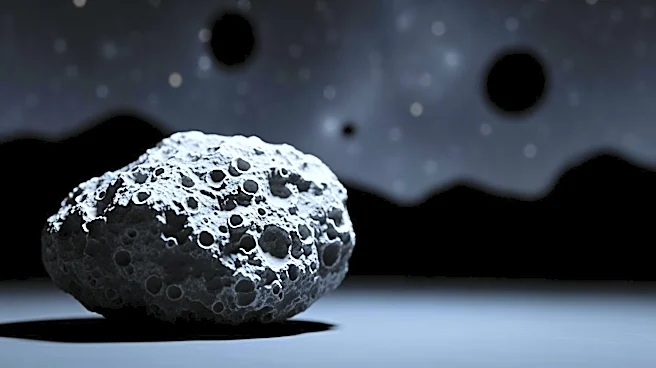
A lunar meteorite, identified as NWA 12593, discovered in northwest Africa, has provided evidence of an asteroid impact on the Moon approximately 3.486 billion years ago. This finding was made by a team led by Carolyn Crow at the University of Colorado
Boulder and published in the journal Geology. The meteorite contains mineralogical signatures of three separate impact events, with the oldest event resulting in the formation of cubic zirconia due to extremely high temperatures. This discovery is significant as it aligns with similar impact records on Earth and the asteroid 4 Vesta, suggesting a shared bombardment event in the inner Solar System during that period.
Why It's Important?
The discovery of the lunar meteorite NWA 12593 is crucial for understanding the early history of the inner Solar System, particularly the period when life was emerging on Earth. The alignment of impact events on the Moon, Earth, and 4 Vesta suggests a common cause, likely the breakup of a large asteroid, which led to a wave of impacts across the inner Solar System. This period coincides with the earliest evidence of life on Earth, raising questions about the role of such impacts in the emergence of life. The findings highlight the Moon's role as a preserved record of events that have been erased from Earth's geological history.
What's Next?
Further research is needed to explore the connection between these ancient impacts and the emergence of life on Earth. Scientists may investigate whether these impacts were destructive or if they contributed to the conditions necessary for life to develop. Additionally, the study of other lunar and meteoritic samples could provide more insights into the early bombardment history of the Solar System and its implications for planetary evolution.
Beyond the Headlines
The study underscores the importance of lunar and meteoritic samples in reconstructing Earth's early history, which has been largely erased by geological processes. The findings also suggest that the early Solar System was more chaotic than previously understood, with significant implications for our understanding of planetary formation and the conditions that led to the emergence of life.