


What's Happening?
The Cambrian period, beginning approximately 540 million years ago, is marked by a phenomenon known as the Cambrian explosion, which saw the geologically sudden appearance and rapid diversification of many major animal lineages in the fossil record. This
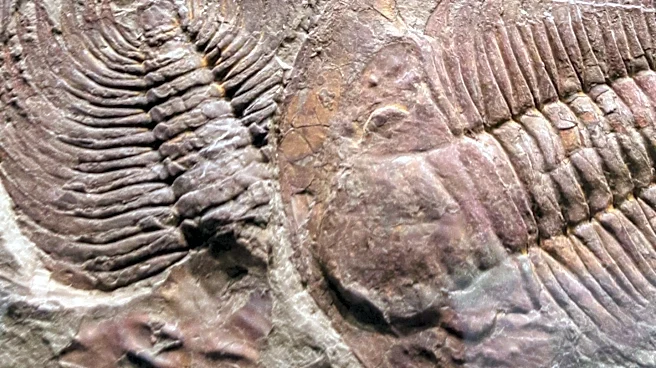
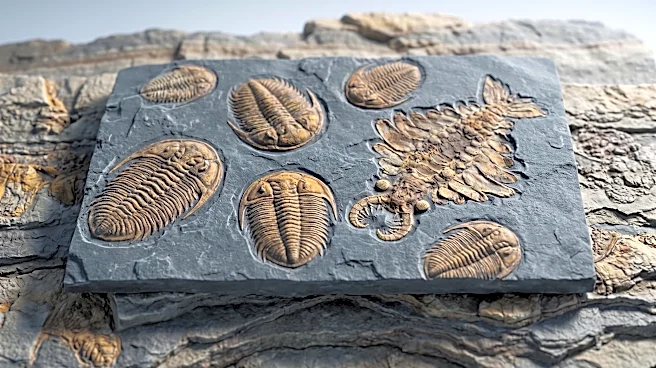
period is characterized by a swift expansion of skeletonized forms and increased ecological complexity, including the emergence of arthropods, molluscs, and early chordates, complete with eyes, limbs, guts, and armor. Key fossil discoveries, particularly from the Burgess Shale in British Columbia, provide exquisite detail of soft-bodied organisms from around 508 million years ago. Notable examples include Anomalocaris, a large predator, and trilobites, which are iconic arthropods that diversified into thousands of species and are used as index fossils for correlating Paleozoic strata.
Why It's Important?
The Cambrian explosion represents a pivotal moment in Earth's history, fundamentally reshaping the biosphere and laying the groundwork for all subsequent animal life. Before this period, life was predominantly microscopic and simple. The rapid emergence of diverse body plans and complex ecological interactions during the Cambrian signifies a major evolutionary leap. This event demonstrates how environmental changes and evolutionary pressures can lead to an accelerated pace of speciation and the development of novel biological features. Understanding the Cambrian explosion helps scientists piece together the timeline of life on Earth, providing insights into the origins of animal diversity and the conditions that facilitate such rapid evolutionary change. The detailed preservation of fossils from sites like the Burgess Shale offers a unique window into these ancient ecosystems, revealing the early stages of complex food webs and predator-prey relationships.
What's Next?
Ongoing paleontological research continues to uncover new Cambrian fossils, refining our understanding of this critical period. Future studies will likely focus on identifying more precise environmental triggers and genetic mechanisms that contributed to the Cambrian explosion. Advances in analytical techniques, such as molecular clock dating and comparative genomics, may further illuminate the evolutionary relationships between Cambrian organisms and modern animal phyla. Additionally, the search for more 'golden spikes'—Global Boundary Stratotype Section and Points (GSSPs)—will continue to provide more accurate chronological markers for the Cambrian and other geological periods, enhancing the precision of the geologic time scale and our ability to correlate events across different regions of the world.
Beyond the Headlines
The Cambrian explosion is not just a biological event; it's a profound illustration of the planet's capacity for radical transformation. The sudden appearance of complex life forms challenges our understanding of evolutionary gradualism and highlights periods of intense biological innovation. It also underscores the importance of geological context, as the conditions on Earth—such as atmospheric oxygen levels and continental configurations—played a crucial role in enabling this burst of life. The study of Cambrian fossils also raises philosophical questions about the nature of life's origins and the potential for similar rapid diversification events on other planets, making it a cornerstone of astrobiological inquiry. The intricate details preserved in these ancient rocks continue to inspire and inform our quest to understand life's deep history.