



What's Happening?
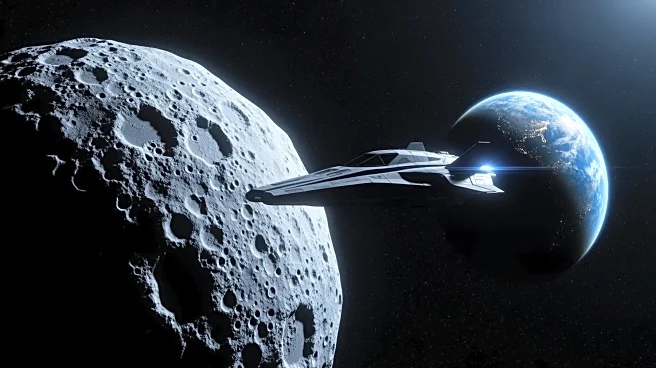
The European Space Agency (ESA) and Japan's JAXA are collaborating on the Ramses mission to study the asteroid Apophis, which will pass within 32,000 kilometers of Earth on April 13, 2029. This close approach, about one-tenth the distance to the Moon,
presents a unique opportunity for scientific discovery. The mission aims to observe how Earth's gravity affects Apophis, providing valuable data to advance planetary defense techniques. The collaboration involves ESA's scientific expertise and JAXA's technological contributions, including a thermal infrared imager. The mission seeks to understand how small celestial bodies behave under gravitational stress, which is crucial for developing asteroid deflection techniques.
Why It's Important?
The Ramses mission is significant for planetary defense, as it could enhance understanding of asteroid deflection methods. By studying Apophis' response to Earth's gravity, scientists hope to gain insights into how to alter an asteroid's trajectory, potentially protecting Earth from future threats. The mission also exemplifies international collaboration in space exploration, with ESA and JAXA working together to advance scientific knowledge. This partnership highlights the importance of global cooperation in addressing challenges in space safety and planetary defense.
What's Next?
As the 2029 flyby approaches, ESA and JAXA will continue to prepare for the Ramses mission, focusing on mission planning and technology development. The data collected during Apophis' close approach will be analyzed to improve asteroid deflection techniques. The mission's findings could influence future planetary defense strategies and international policies on space safety. Additionally, the collaboration between ESA and JAXA may pave the way for further joint efforts in space exploration and research.