
What's Happening?
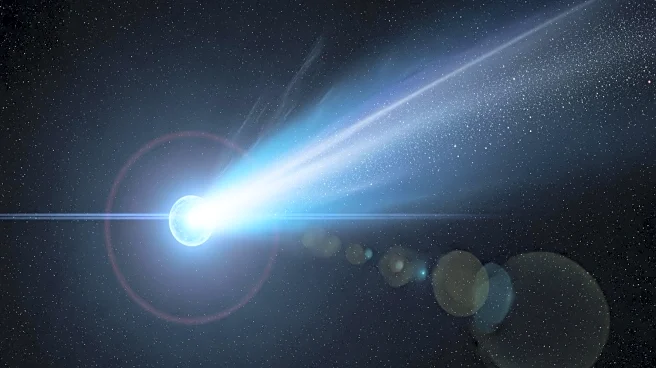
NASA's Hubble Space Telescope has captured new images of the interstellar comet 3I/ATLAS, confirming its continued activity even after its close approach to the Sun. This comet, only the third interstellar object
observed in our solar system, is providing scientists with valuable data on its path and behavior. The Hubble images reveal a bright core surrounded by a cloud of gas and dust, indicating ongoing activity. Observations from NASA's Psyche mission and the European Space Agency's JUICE spacecraft have also contributed to refining the comet's trajectory. The comet is currently moving away from the Sun and will be closest to Earth around December 19, although it is not visible to the naked eye.
Why It's Important?
The study of 3I/ATLAS offers significant insights into the nature of interstellar objects, which are rare visitors to our solar system. Understanding the composition and behavior of such comets can enhance our knowledge of the universe beyond our solar system. The data collected from 3I/ATLAS could inform future missions and research on interstellar phenomena. Additionally, the ability to track and analyze these objects helps improve our understanding of potential threats or opportunities they may present to Earth and its vicinity.
What's Next?
As 3I/ATLAS continues its journey away from the Sun, scientists will keep monitoring its activity using various telescopes and spacecraft. The comet's closest approach to Earth in mid-December will provide further opportunities for observation, particularly for those with telescopes. Continued study of 3I/ATLAS will likely yield more information about its composition and origin, contributing to the broader field of astronomy and interstellar research.