





What's Happening?
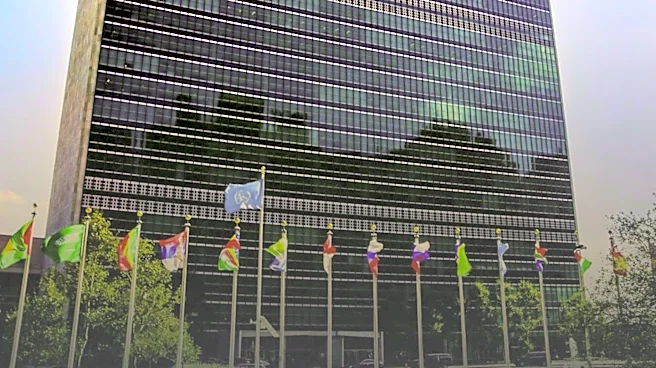
For decades, the United Nations has been engaged in continuous reform efforts, with Member States promising to 'upgrade' the organization for its 75th anniversary in 2020, followed by the 'Pact for the Future' and now 'UN80.' These initiatives aim to transform
global governance and reinvigorate the multilateral system. However, despite these ongoing efforts, the world surrounding the UN is fragmenting rapidly, leading to intensifying geopolitical competition and growing skepticism towards multilateralism. This situation has prompted a critical question: what unique functions can the UN perform that no other entity can? Experts Nudhara Yusuf and Jack Toole, from different professional backgrounds, agree that the UN must become leaner and more disciplined, focusing its attention and capacity where its universality, neutrality, convening power, and reach are most impactful. Their differing views lie in the scope of these essential functions.
Why It's Important?
The ongoing debate about the UN's core functions and the effectiveness of its reform efforts is crucial for the future of global governance. In an era of increasing geopolitical fragmentation and skepticism towards multilateralism, the UN's ability to adapt and demonstrate its unique value is paramount. If the UN fails to identify and excel in functions that cannot be replicated elsewhere, its credibility and legitimacy could further erode. This would have significant implications for addressing global challenges such as climate change, pandemics, and artificial intelligence governance, which require universal cooperation. The discussion also highlights the evolving role of middle powers in bridging geopolitical divides and building consensus, suggesting a potential shift in how collective action is driven within the UN system. The outcome of these reform discussions will shape the UN's relevance and capacity to foster international cooperation in a complex and rapidly changing world.
What's Next?
The strategic choice facing the next Secretary-General will be central to defining the UN's future. This leader, along with Member States, must decide where the UN is uniquely useful, where other actors might be better suited, and how to allocate its scarce political and financial capital effectively. The challenge lies in determining when ambition creates political space for cooperation versus when it dilutes credibility by promising more than Member States are willing to deliver. The ongoing UN80 process is expected to deliver 'the how' of reform, building on previous frameworks. The focus will be on ensuring the UN concentrates its efforts on areas where its universal reach and convening power are indispensable, such as keeping adversaries in contact, brokering deals, coordinating technical regimes, and solving collective-action problems with clear objectives.
Beyond the Headlines
The continuous cycle of UN reform, from the SDGs to the Pact for the Future and UN80, reflects a deeper struggle within the international community to adapt institutions designed in a post-war era to contemporary global realities. The fragmentation of the international system and the rise of states refusing to align with permanent geopolitical blocs challenge the traditional power dynamics within the UN. This necessitates a re-evaluation of how power is exercised and how consensus is built. The ethical dimension involves ensuring that reforms genuinely serve the global public good rather than merely preserving existing architectural elements. The long-term implication is whether the UN can evolve into a more agile and focused organization that effectively addresses 21st-century challenges, or if it will continue to be perceived as an institution struggling to keep pace with a rapidly changing world, potentially leading to alternative, less inclusive forms of global governance.