








What's Happening?
IonQ, a quantum computing company, has received $7.5 million in follow-on funding from the Air Force Research Laboratory (AFRL). This Phase 2 contract aims to expand and upgrade a quantum network previously established by IonQ in Rome, New York. The initial
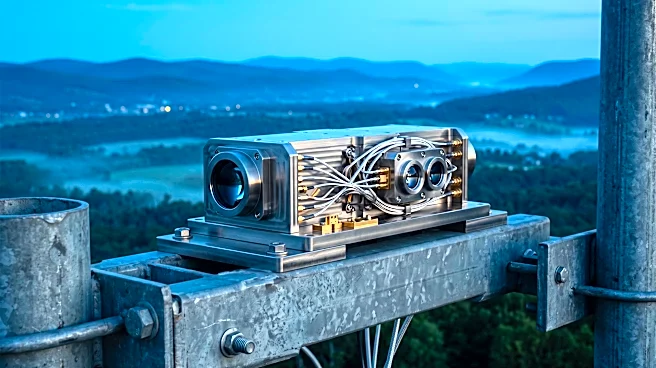
Phase 1 focused on building the core physical network foundation. The new funding will introduce advanced capabilities to connect different types of quantum hardware in non-laboratory environments. Key upgrades include free-space optical links with automatic pointing, acquisition, and tracking for secure quantum channels, quantum frequency converters to ensure interoperability across various quantum and classical hardware using standard telecom wavelengths, and automated control software for real-time monitoring and experiment execution. Additionally, upgraded hardware modules, such as O-band-compatible network hardware and enhanced polarization controls, will be implemented. These enhancements are designed to support quantum communications over standard telecommunications infrastructure and open air, advancing AFRL’s goal of interoperable quantum networks in metropolitan and defense settings. This award was part of an originally announced $21.1 million collaboration from January 2025.
Why It's Important?
This funding is significant as it underscores the U.S. government's continued investment in quantum networking technologies for defense and metropolitan applications. For IonQ, it validates their full-stack approach to quantum solutions and demonstrates the practical applicability of their technology beyond laboratory settings. The development of interoperable quantum networks capable of operating over standard telecom infrastructure and open air is crucial for future secure communications, particularly in defense. This project aims to bridge the gap between theoretical quantum demonstrations and real-world field deployments, providing a deployable model for future defense communications, enterprise infrastructure, and multi-node quantum networks. The ability to connect diverse quantum systems and route quantum communication similarly to how classical routers share data across the internet represents a major step forward in quantum technology adoption. This initiative could position the U.S. at the forefront of quantum communication capabilities, offering enhanced security and resilience for critical infrastructure.
What's Next?
The Phase 2 funding will lead to the immediate implementation of the specified hardware and software upgrades in the Rome, New York quantum network. IonQ will focus on deploying free-space optical links, quantum frequency converters, and advanced control software to enable connectivity between different quantum systems in real-world environments. This work will serve as a critical testbed for heterogeneous quantum networking, providing valuable insights for future defense communications and enterprise infrastructure. The success of this deployment could lead to further contracts and broader adoption of IonQ's quantum networking solutions within government and potentially commercial sectors. The project's outcomes will also inform AFRL's broader roadmap for quantum networking, potentially influencing future national quantum technology strategies and investments. Continued collaboration between IonQ and AFRL is expected to drive further innovation in quantum communications and security.
Beyond the Headlines
This development highlights a broader strategic shift towards integrating quantum technologies into national security and critical infrastructure. The emphasis on 'full-stack' solutions, encompassing optical, hardware, and software layers, indicates a move towards comprehensive, deployable quantum systems rather than isolated components. The ability to transmit quantum information over open air and standard telecommunications infrastructure addresses key challenges in scalability and accessibility, which are vital for widespread adoption. Furthermore, the project's focus on interoperability between heterogeneous quantum systems is crucial for building a robust quantum internet, allowing different quantum devices to communicate seamlessly. This initiative could also spur the development of a specialized quantum workforce, as the deployment and maintenance of such advanced networks require unique expertise. The long-term implications include enhanced cybersecurity capabilities, resilient communication networks, and potential advancements in distributed quantum computing, fundamentally altering how sensitive information is protected and processed.