





What's Happening?
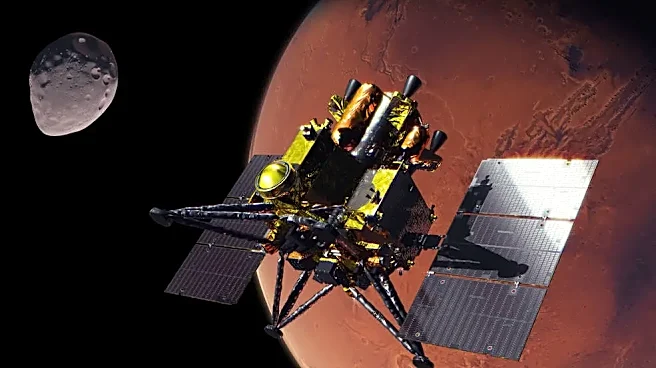
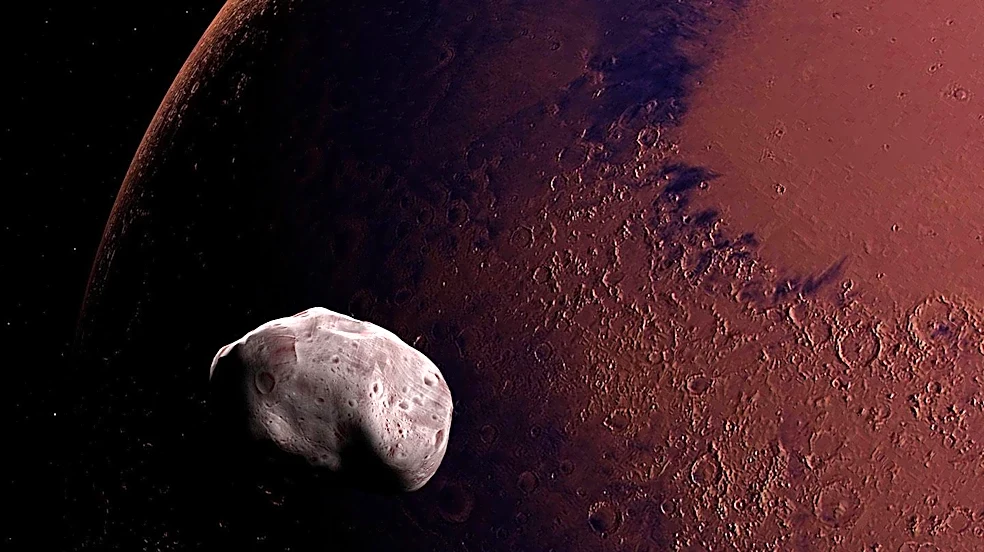
The National Aeronautics and Space Administration (NASA) is a key international partner in the Japan Aerospace Exploration Agency's (JAXA) Martian Moons eXploration (MMX) mission. This mission, set to launch on October 20, 2026, aims to land on Phobos,
one of Mars' moons, collect a minimum of 10 grams of surface material, and return it to Earth by 2031. NASA is contributing science support and instrumentation through its planetary science division, viewing the mission as an opportunity to unravel mysteries surrounding Mars' moons. The MMX mission is a collaborative effort involving JAXA, NASA, the Centre National d’Études Spatiales (CNES) from France, the German Aerospace Center (DLR), and the European Space Agency (ESA). The primary scientific goal is to determine whether Phobos originated from a captured asteroid or from debris ejected during a giant impact on Mars.
Why It's Important?
This international collaboration underscores a growing trend in space exploration where the high costs and complexities of deep-space missions necessitate multi-agency partnerships. For the U.S., NASA's involvement ensures American scientific expertise and instrumentation contribute to a groundbreaking mission that could fundamentally alter our understanding of planetary formation and the solar system's history. The mission's success would provide invaluable physical samples, offering a definitive answer to the long-standing debate about Phobos's origin, which orbital observations alone have been unable to resolve. This scientific payoff would be shared among research teams in the U.S. and other participating nations, fostering international scientific cooperation and advancing global knowledge in planetary science. Furthermore, the mission's success would validate the effectiveness of such collaborative models for future large-scale space endeavors.
What's Next?
Following the scheduled launch on October 20, 2026, the MMX spacecraft is expected to reach the Mars system by August 2027 and enter orbit around Phobos the following month. Sample collection is planned for no earlier than December 2028, targeting two distinct surface sites on Phobos. The collected material will then embark on a journey back to Earth, with a planned return in 2031 to the Woomera Prohibited Area in South Australia. NASA, along with its international partners, will likely publish joint scientific communications as the mission progresses, particularly when MMX reaches Mars orbit in 2027 and during the critical sample collection phase in 2028. The success of this mission could pave the way for more ambitious international sample-return missions from other celestial bodies.
Beyond the Headlines
The MMX mission represents more than just a scientific endeavor; it signifies a strategic shift towards shared responsibility and resource optimization in space exploration. By distributing instrument development, tracking support, and sample analysis across multiple agencies, the financial burden and technical risks are mitigated, making such ambitious projects feasible. This model of international cooperation could become the standard for future complex space missions, fostering a global scientific community and accelerating the pace of discovery. The mission also carries significant reputational weight; a successful return of physical material from the Mars system would be a historic first, setting a precedent for future sample-return missions and potentially influencing the design and funding of subsequent planetary science initiatives globally.