



What's Happening?
William Bond, an emeritus professor at the University of Cape Town and chief scientist of South Africa’s Environmental Observation Network, has been a vocal advocate for the preservation of grasslands and savannas. Bond argues against the widespread belief
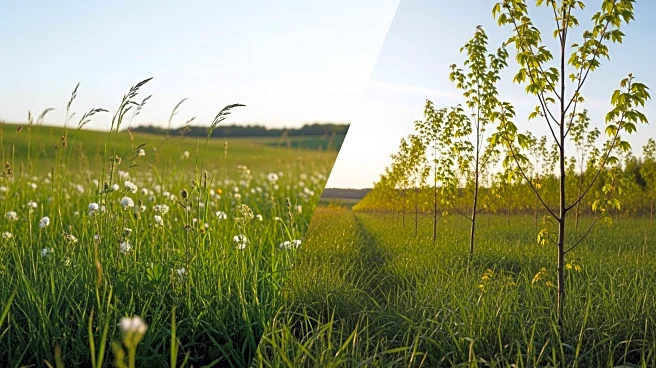
that planting trees is a universal remedy for climate change. He emphasizes that many areas assumed to be degraded forests are actually ancient grasslands and savannas, which are complex ecosystems maintained by natural processes such as fire and herbivory. Bond's work highlights the importance of recognizing these ecosystems as valuable in their own right, rather than viewing them as failed woodlands in need of reforestation. His research has shown that careless tree planting can disrupt these ecosystems, which are crucial for biodiversity and carbon storage.
Why It's Important?
Bond's advocacy is significant as it challenges the prevailing narrative in environmental policy that tree planting is a catch-all solution for climate issues. His work underscores the need for a nuanced understanding of different ecosystems and their roles in the environment. By highlighting the ecological importance of grasslands and savannas, Bond's research calls for a more informed approach to conservation efforts. This perspective is crucial for policymakers and conservationists who may otherwise implement well-intentioned but potentially harmful environmental strategies. Bond's insights could lead to more effective climate policies that respect the diversity of ecosystems and their unique contributions to global ecological health.
What's Next?
The implications of Bond's work suggest a need for a shift in environmental policy and conservation strategies. Policymakers and environmental organizations may need to reassess their approaches to climate solutions, considering the specific needs and characteristics of different ecosystems. This could involve increased research and funding for the preservation of grasslands and savannas, as well as a reevaluation of reforestation projects that do not account for the ecological context. Bond's findings may also inspire further scientific inquiry into the roles of various ecosystems in climate regulation, potentially influencing future environmental legislation and international climate agreements.
Beyond the Headlines
Bond's work raises important ethical and cultural questions about how societies value different types of landscapes. The emphasis on tree planting as a climate solution reflects a cultural bias towards forested landscapes, often at the expense of open ecosystems like grasslands. This bias can lead to the marginalization of communities that depend on these ecosystems for their livelihoods. Bond's advocacy for grasslands challenges this perspective, promoting a more inclusive understanding of nature that recognizes the value of all ecosystems. His work also highlights the importance of slowing down decision-making processes to ensure that environmental actions are based on sound scientific understanding rather than simplistic solutions.