




What's Happening?
NASA Ames Research Center has honored four scientists as the Science Stars of the Month for July 2026, acknowledging their significant contributions to various NASA missions. The recognized individuals are Sungshin Choi, Yi-Chun Chen, Emma Yates, and
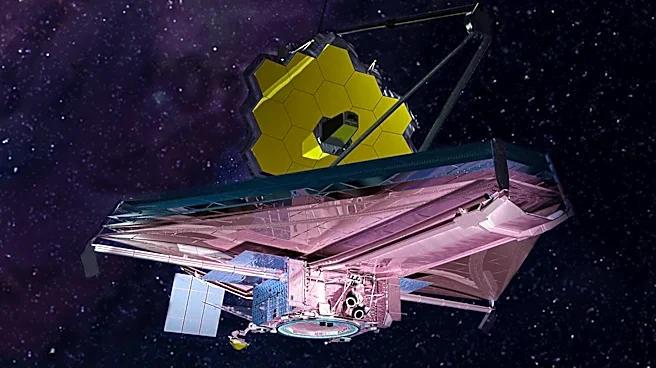
Eduardo Bendek. Sungshin Choi and Yi-Chun Chen, both project scientists with Amentum in the Space Biosciences Division, have been pivotal in supporting numerous space biology flight investigations, including CBIOMES and Space Algae II. Emma Yates, a research scientist with the Bay Area Environmental Research Institute, has advanced NASA's Ozone Where We Live (OWWL) project by fostering community engagement and developing air quality monitoring networks. Eduardo Bendek, an optical scientist with the SETI Institute, has contributed to the Ames Coronagraph Testbed (ACT) project, crucial for the development of the Habitable Worlds Observatory.
Why It's Important?
The recognition of these scientists underscores the critical role of interdisciplinary collaboration in advancing NASA's mission. Their work not only supports the development of space exploration technologies but also enhances our understanding of Earth's environment. The contributions of Choi and Chen in space biosciences are vital for future space missions, potentially impacting how humans live and work in space. Yates' efforts in Earth science promote public engagement and environmental awareness, which are essential for addressing climate change. Bendek's work in space science aids in the search for habitable worlds, expanding our knowledge of the universe. These achievements highlight the importance of scientific innovation and collaboration in addressing both terrestrial and extraterrestrial challenges.
What's Next?
The ongoing projects led by these scientists are expected to continue making significant impacts. The space biology investigations supported by Choi and Chen will likely contribute to future NASA missions, providing insights into biological processes in microgravity. Yates' community-based air quality monitoring networks are set to expand, offering valuable data for environmental research and policy-making. Bendek's work on the Ames Coronagraph Testbed will advance the capabilities of the Habitable Worlds Observatory, potentially leading to groundbreaking discoveries in exoplanet research. These initiatives will require continued collaboration and support from NASA and its partners to achieve their full potential.