





What's Happening?
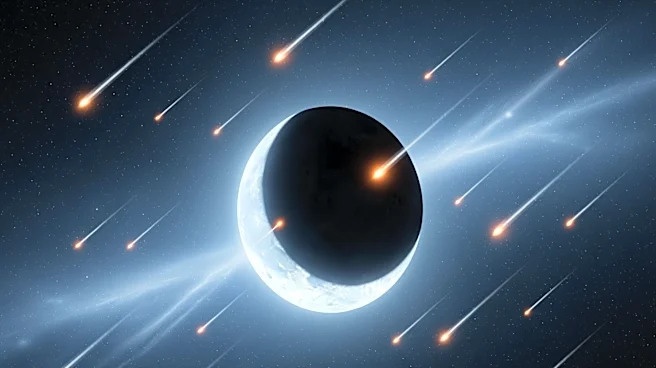
Recent research published in Communications Earth & Environment reveals that the asteroid impact that led to the extinction of non-avian dinosaurs 66 million years ago may have created a hydrothermal vent system lasting up to eight million years. This
finding challenges previous models that estimated the duration of such activity at the Chicxulub impact site to be only two million years. Scientists, including Annemarie Pickersgill, analyzed samples from the peak-ring crater of the impact site, using argon isotope ratios to date the hydrothermal system. The study suggests that the porous, fractured rocks from the impact created microenvironments conducive to life, potentially offering insights into similar processes on other planets like Mars.
Why It's Important?
The discovery of prolonged hydrothermal activity at the Chicxulub site has significant implications for understanding the resilience and adaptability of life in extreme environments. This research not only sheds light on Earth's past ecosystems but also informs the search for life on other planets. The conditions that allowed life to thrive in the aftermath of the asteroid impact could be analogous to environments on Mars, guiding future space exploration missions in identifying potential habitats for life. This study underscores the importance of interdisciplinary research in uncovering the complex history of life on Earth and beyond.
What's Next?
The findings from the Chicxulub impact site may influence future planetary exploration strategies, particularly in selecting impact craters on Mars for investigation. Scientists will likely continue to study the Chicxulub site to further understand the extent and nature of hydrothermal activity. Additionally, the research community may explore similar impact sites on Earth to compare and contrast hydrothermal systems, potentially leading to new insights into the conditions that support life in extreme environments.
Beyond the Headlines
The study highlights the potential for impact craters to serve as cradles of life, offering protection from harsh surface conditions. This has broader implications for astrobiology, as it suggests that life could emerge or persist in unexpected places. The research also raises questions about the role of asteroid impacts in shaping the evolutionary trajectory of life on Earth, potentially influencing biodiversity and ecological dynamics over geological timescales.