

What's Happening?
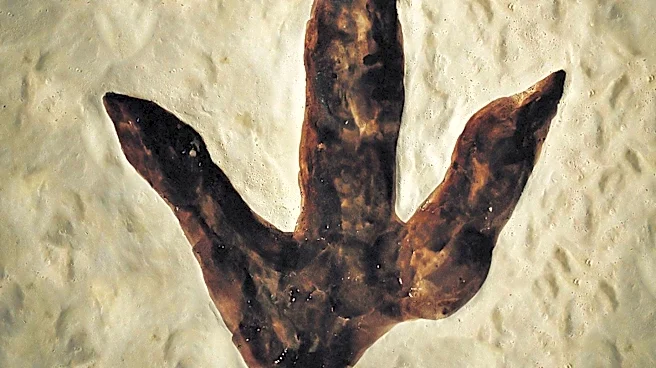
A new study has uncovered fossil footprints in northern Kenya, providing a rare glimpse into the behavior of Paranthropus boisei, an ancient hominin species. The footprints, dating back 1.4 million years, were found along a lakeshore and suggest that
eight individuals, likely adult males, traveled together. This finding challenges previous assumptions about the body size of Paranthropus boisei, indicating they were larger than previously thought, with human-like dimensions. The research, led by Kevin Hatala and involving an international team, used advanced analytical methods to identify the footprints and assess their significance. The study highlights the importance of lake margins as key habitats for ancient human relatives, offering insights into their social structures and environmental interactions.
Why It's Important?
This discovery is significant as it provides new insights into the social dynamics and physical characteristics of Paranthropus boisei, a species that lived alongside early Homo species. The findings suggest a complex social structure, with adult males possibly forming groups for safety or competition. This challenges previous notions of their size and social behavior, offering a more nuanced understanding of human evolution. The research also underscores the importance of lake environments in the lives of ancient hominins, suggesting these areas were crucial for their survival and social interactions. Such studies enhance our understanding of human ancestry and the evolutionary paths that led to modern humans.
What's Next?
The research team plans to continue their work in Kenya, aiming to uncover more fossil footprints and further explore the social and environmental contexts of ancient hominins. By combining new analytical techniques with fieldwork, they hope to build a more comprehensive picture of early human relatives' lives. This ongoing research could lead to more discoveries about the interactions between different hominin species and their environments, potentially reshaping our understanding of human evolution.