



What's Happening?
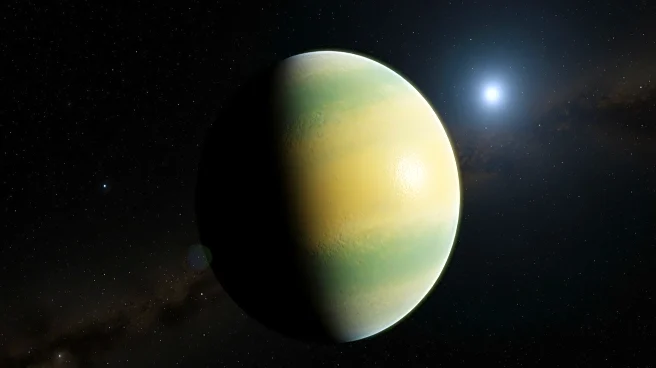
NASA's James Webb Space Telescope has observed an exoplanet, PSR J2322-2650b, with a unique lemon shape and an inexplicable atmospheric composition. Discovered in 2017, this exoplanet orbits the pulsar PSR J2322-2650, located 750 light-years from Earth.
The pulsar emits high-energy particles, allowing the telescope to study the exoplanet without interference. The exoplanet's unusual shape is attributed to the strong gravitational pull from the pulsar, which is about 1.4 times the mass of the Sun but only 10-20 km in diameter. The study of this exoplanet provides insights into the effects of extreme gravitational forces on planetary bodies.
Why It's Important?
The observation of PSR J2322-2650b is significant for astrophysics as it challenges existing theories about planetary formation and atmospheric composition. Understanding such unique celestial bodies can provide insights into the diversity of planetary systems and the potential for life in extreme environments. The findings could influence future research directions and the development of new models to explain planetary phenomena. This discovery also highlights the capabilities of the James Webb Space Telescope in exploring distant and complex astronomical objects.