



What's Happening?
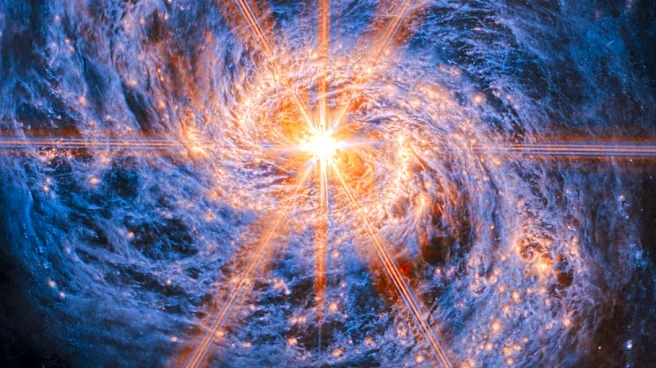
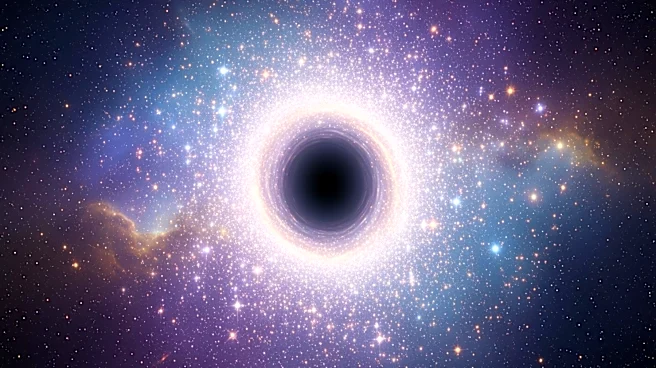
The James Webb Space Telescope (JWST) has identified a unique X-ray-emitting black hole that could help solve the mystery of 'little red dots' (LRDs), a class of objects observed in the early universe. These LRDs, first spotted by JWST in 2022, appear
as red due to their light being redshifted over billions of light-years. A recent study published in The Astrophysical Journal Letters describes an object, 3DHST-AEGIS-12014, or the 'X-ray dot' (XRD), which was initially hidden in a survey by NASA's Chandra X-ray Observatory. The XRD's discovery could illuminate the nature of LRDs, which are thought to be young black holes enveloped in gas. The XRD's X-ray emissions suggest that LRDs might be rapidly growing supermassive black holes, with their X-rays blocked by gas cocoons. This finding could explain how early supermassive black holes accumulated mass quickly.
Why It's Important?
This discovery is significant as it provides insights into the formation and evolution of supermassive black holes in the early universe. Understanding LRDs could reveal how these massive entities grew so rapidly, offering clues about the universe's evolution. The study also highlights the value of archival data in solving cosmic mysteries, demonstrating the ongoing scientific contributions of legacy space programs. The findings could influence future astronomical research and the development of new theories about black hole growth and the early universe's dynamics.
What's Next?
Future observations with next-generation telescopes like the Nancy Grace Roman Space Telescope will aim to find modern analogues of LRDs, which are rare in the evolved universe. These efforts will help refine our understanding of black hole formation and the conditions that allow for rapid growth. Continued study of the XRD and similar objects will further elucidate the processes behind black hole evolution and the role of gas accretion in the early universe.