

What's Happening?
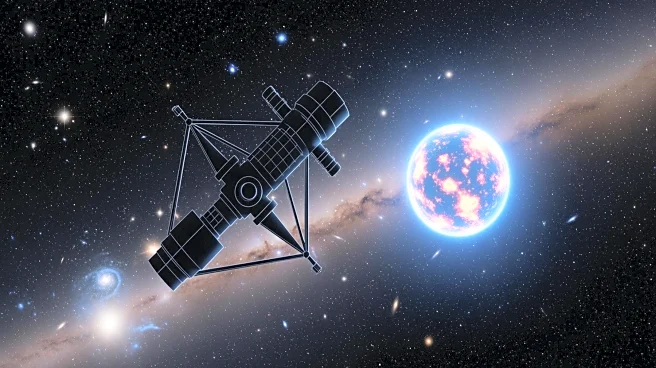
The European Space Agency's Characterizing ExOPlanet Satellite (CHEOPS) has discovered a fourth exoplanet in the LHS 1903 system, located 116 light-years away in the constellation Lynx. This discovery is significant because it challenges existing theories
of planetary formation. The newly identified planet, LHS 1903e, is a rocky world situated beyond two gas giants, which contradicts the traditional model where rocky planets form closer to the star and gas giants form further out. The system consists of two rocky planets and two mini-Neptune gas dwarfs. The discovery was made possible by the precision of CHEOPS, which has been operational since 2019. The study, published in the journal Science, was conducted by an international team of astronomers from the University of Bern, the National Center of Competence in Research PlanetS, and the University of Geneva.
Why It's Important?
This discovery is crucial as it challenges the conventional understanding of planetary formation, which posits that rocky planets form close to their stars while gas giants form further away. The presence of a rocky planet beyond gas giants in the LHS 1903 system suggests that planetary systems can form in diverse and unexpected ways. This could lead to a reevaluation of existing models and theories, potentially impacting our understanding of how planets, including those in our solar system, are formed. The findings could also influence future exoplanet exploration and the search for habitable worlds, as they suggest that the conditions for planet formation are more varied than previously thought.
What's Next?
The discovery of LHS 1903e opens up new avenues for research into planetary formation. Scientists may focus on understanding the mechanisms that allow rocky planets to form beyond gas giants. Further observations and studies could reveal whether this is a common occurrence in other planetary systems or a unique feature of LHS 1903. The CHEOPS mission will continue to search for and study exoplanets, potentially uncovering more systems that defy current theories. This could lead to the development of new models that better explain the diversity of planetary systems observed in the universe.