



What's Happening?
Observations of three diffuse galaxies—DF2, DF4, and DF9—reveal that they contain little to no dark matter, challenging existing theories of gravity and providing strong evidence for dark matter as a distinct physical entity. These galaxies, located approximately
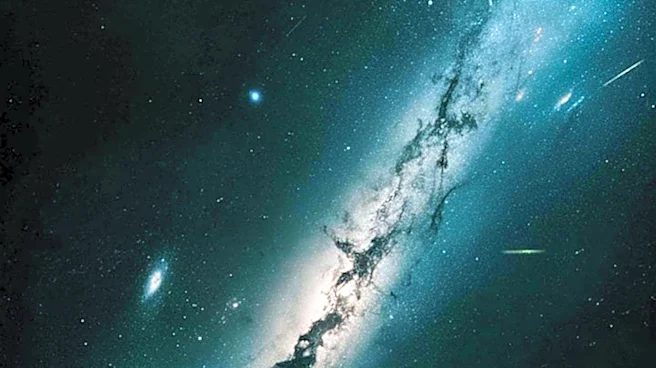
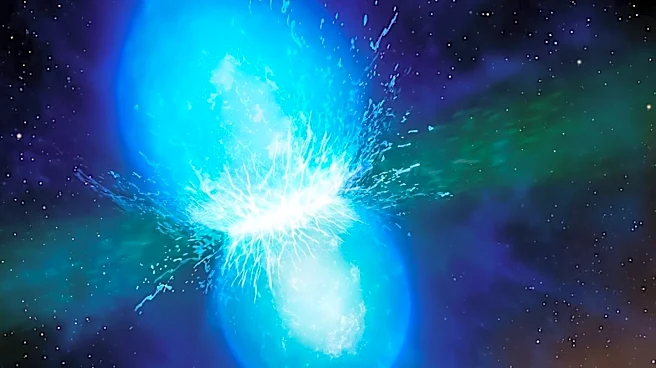
65 million light-years from Earth, are unusually dim and translucent, containing significantly fewer stars than typical galaxies of similar size. A study published in June 2026 in The Astrophysical Journal suggests that an ancient cosmic impact stripped these objects of their unseen mass. This discovery allows astronomers to study how normal matter behaves in isolation and supports the idea that dark matter is a separate physical substance rather than a flaw in our understanding of gravity. The prevailing theory is that a violent collision between two precursor galaxies caused their normal baryonic matter to interact and stall, while their dark matter halos passed through each other unimpeded due to dark matter's purely gravitational interactions.
Why It's Important?
This discovery is crucial for astrophysics and cosmology, as it provides compelling empirical evidence for the existence of dark matter. For decades, dark matter has been considered an essential component for the formation and stability of galaxies, yet direct detection has remained elusive. The observation of galaxies almost entirely devoid of dark matter directly challenges Modified Newtonian Dynamics (MOND), a theory that proposes gravity changes at extremely low accelerations instead of dark matter's existence. If MOND were universally true, galaxies with similar visible mass should exhibit identical gravitational effects, which is contradicted by the vastly different internal gravitational pulls observed in these dark-matter-deficient galaxies. This finding reinforces the standard cosmological model, which posits that dark matter accounts for approximately 27% of the universe's mass and is vital for cosmic architecture.
What's Next?
While the collision model offers a convincing explanation, some unresolved questions remain. Researchers like Kinwah Wu suggest that the lack of typical tidal debris in the galaxies' vicinity could indicate alternative mechanisms, such as tidal stripping by a dense cluster of massive galaxies. Future research will likely focus on refining simulations of galactic collisions and exploring other potential scenarios that could lead to such a significant separation of dark and ordinary matter. Continued observations of these and similar diffuse galaxies will be critical to further validate the collision hypothesis and to rule out alternative explanations. The findings will also likely spur further efforts in direct dark matter detection experiments, as the physical absence of dark matter in these galaxies strengthens the case for its reality elsewhere.
Beyond the Headlines
The implications of this research extend beyond confirming dark matter's existence; it offers a unique 'natural laboratory' to study the behavior of ordinary matter in the absence of a dominant dark matter halo. This could lead to a deeper understanding of galaxy formation and evolution, particularly for dwarf galaxies. The challenge posed to MOND also highlights the scientific process of testing and refining fundamental theories. The ability to observe such a clear separation of dark and ordinary matter, akin to observations in the Bullet Cluster, underscores the distinct physical properties of dark matter—its non-interaction with electromagnetic or nuclear forces. This distinction is fundamental to our understanding of the universe's composition and the forces that govern it, potentially guiding future theoretical and experimental physics research.