







What's Happening?
The Inflation Reduction Act's (IRA) Energy Community Bonus, designed to stimulate clean-energy investment and job creation in areas affected by the energy transition, has significantly increased solar investment but shown little impact on employment.
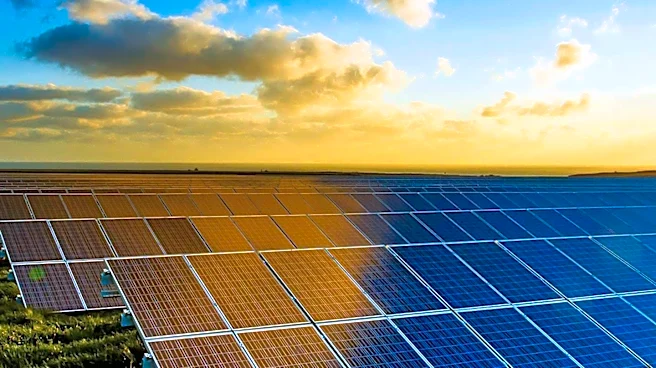
For new plants in an Energy Community, the Investment Tax Credit (ITC) for solar increased from 30% to 40%, while the Production Tax Credit (PTC) for wind increased from $27.50 to $30.25 per megawatt hour. This resulted in a 144% rise in the probability of a designated census tract receiving solar investment. However, solar-related job vacancies only saw a weak, marginally significant 29% increase, and no effect was observed on wind vacancies or aggregate employment. The policy's impact on political attitudes and voting patterns also remained negligible through the 2024 election.
Why It's Important?
This finding highlights a critical distinction between investment and job creation in the clean energy sector, particularly for capital-intensive utility-scale solar projects. While the IRA successfully directed substantial capital to energy communities, the expected broad local employment gains did not materialize. This poses a challenge for policymakers aiming to revive economically vulnerable regions and build political support for decarbonization. The asymmetry in incentives, with a larger proportional increase for the ITC (favored by solar) than the PTC (favored by wind), explains the differential impact on the two technologies. The limited job growth suggests that attracting capital alone may not be sufficient to address the socio-economic challenges of the energy transition, potentially undermining the policy's broader objectives of equitable development and political consensus.
What's Next?
The weak employment response and lack of political shift suggest that future place-based policies aimed at revitalizing local labor markets may need to prioritize activities that generate substantial employment. The experience with the Energy Community Bonus indicates that while it was highly effective as a climate policy in terms of carbon abatement cost, its effectiveness as a regional job creation policy was less favorable. Policymakers might need to recalibrate incentives to specifically target labor-intensive aspects of the clean energy supply chain or integrate complementary programs focused on workforce development and job training. The sharp acceleration of the phase-out of wind and solar credits in 2025, ending eligibility for most new projects ahead of the IRA's original schedule, further complicates the outlook for sustained investment and job growth in these communities.
Beyond the Headlines
The IRA's Energy Community Bonus reveals a deeper tension between the goals of rapid decarbonization and equitable economic development. While the policy successfully spurred solar investment, the failure to generate significant local employment raises ethical and social questions about the 'just transition' for communities historically reliant on fossil fuels. It underscores the need for a more nuanced understanding of how different clean energy technologies impact local economies. The capital-intensive nature of utility-scale solar means that while it contributes to climate goals, its direct job creation per dollar invested might be lower than other sectors. This necessitates a holistic approach that combines investment incentives with targeted labor market interventions, ensuring that the benefits of the green economy are broadly shared and do not exacerbate existing regional inequalities.