




What's Happening?
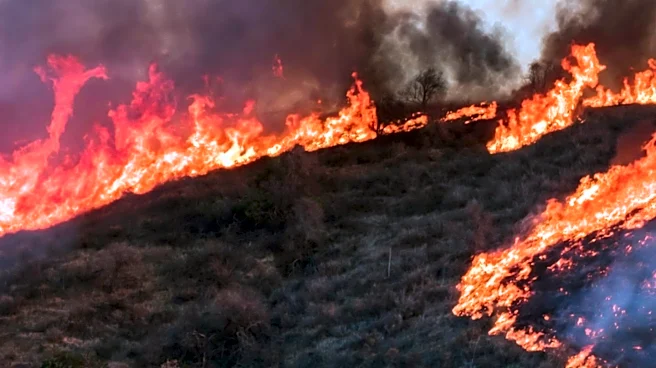
A global satellite study conducted by Huipeng Xi and Qunming Wang at Tongji University in Shanghai has revealed that ecosystems affected by both drought and wildfire simultaneously become more sensitive to rainfall but less efficient at absorbing carbon.
The study, which analyzed satellite data from 2001 to 2022, identified nearly 200,000 compound meteorological drought-fire and hydrological drought-fire events. These events cause a decoupling of the normal relationship between plant growth and water use, where vegetation struggles to recover effectively. After such compound events, over 54% of vegetated areas showed increased sensitivity to precipitation, while water-use efficiency—the ratio of carbon gained to water consumed—declined across most of these same areas. This suggests that ecosystems enter a fragile recovery state, impacting their ability to function as carbon sinks.
Why It's Important?
This research highlights a critical vulnerability in Earth's natural carbon defenses, which has significant implications for global climate change mitigation efforts. Ecosystems, particularly forests, play a vital role in absorbing carbon dioxide from the atmosphere. If these systems become less efficient at carbon absorption due to compound drought-fire events, the rate at which atmospheric CO2 is removed could decrease, potentially accelerating global warming. For the U.S., which experiences frequent wildfires and droughts in regions like the West, this finding suggests that the long-term recovery of affected areas might be more challenging than previously understood. The weakened carbon-water balance in these ecosystems could lead to a less predictable and less effective terrestrial carbon sink, impacting national climate goals and increasing the urgency for robust climate adaptation and mitigation strategies.
What's Next?
The study's findings suggest that climate projections, which often assume a stable relationship between rainfall and photosynthesis, may need to be re-evaluated to accurately model the future of terrestrial carbon sinks. Researchers recommend using indicators like vapor pressure deficit and soil nutrient status as early-warning signals for ecosystems at risk. As climate extremes are projected to become more frequent, the cumulative effect of these compound events on the global carbon cycle could be substantial. Policymakers and land managers in the U.S. and globally may need to develop more integrated strategies that account for the combined impacts of drought and fire, focusing on ecosystem resilience and recovery. This could involve enhanced monitoring, targeted restoration efforts, and policies aimed at reducing the frequency and intensity of these compound disturbances.
Beyond the Headlines
The decoupling of carbon and water processes in ecosystems after compound drought-fire events points to a deeper ecological shift. This phenomenon suggests that the resilience of natural systems to climate change may be eroding in ways that are not immediately obvious. The long-term consequences could include not only reduced carbon sequestration but also broader impacts on biodiversity, soil health, and water cycles, creating a cascade of environmental problems. Ethically, this research underscores the responsibility to protect and restore natural ecosystems, recognizing their intrinsic value and their critical role in maintaining planetary health. It also challenges the assumption that nature can indefinitely absorb human-induced environmental pressures, urging a more profound re-evaluation of human-environment interactions and the need for systemic change in climate policy and land management practices.