
What's Happening?
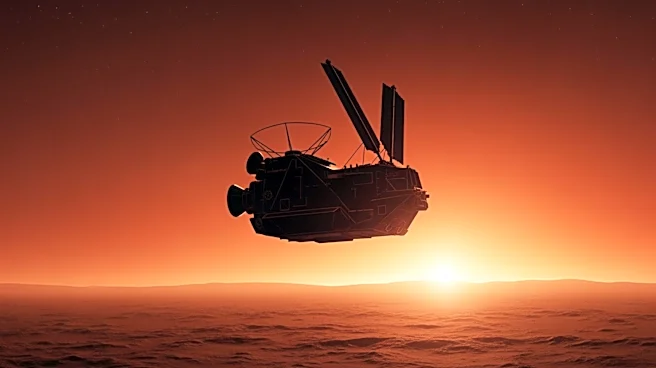
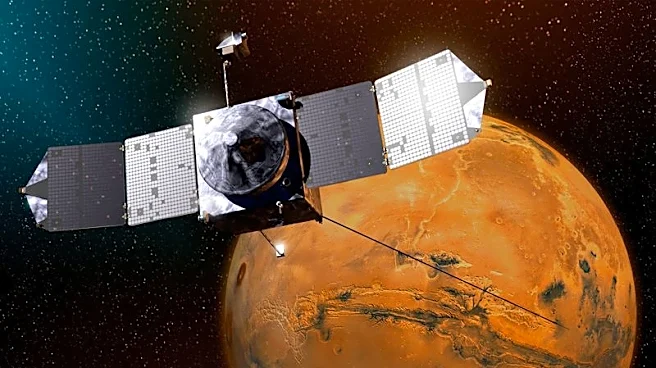
NASA has officially ended the Mars Atmosphere and Volatile Evolution (MAVEN) mission after more than 11 years of operation. The spacecraft, which was the first dedicated to studying the Martian atmosphere,
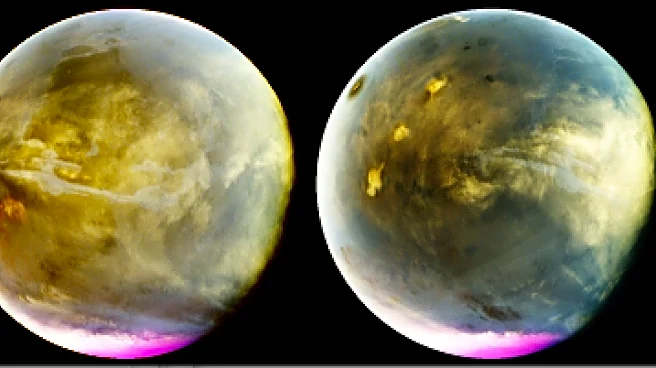
lost contact with NASA's Deep Space Network on December 6, 2025, after passing behind Mars. An anomaly review board determined that the spacecraft is unrecoverable due to a high rotation rate that drained its batteries, leading to a loss of communication. MAVEN's mission, which began in November 2013, provided significant insights into the Martian atmosphere, including the effects of solar storms and atmospheric loss. The mission also played a crucial role in relaying data from Mars rovers to Earth.
Why It's Important?
The conclusion of the MAVEN mission marks the end of a significant chapter in Mars exploration. The data collected by MAVEN has been instrumental in understanding the Martian atmosphere and its evolution, which is crucial for future human missions to Mars. The insights gained from MAVEN help inform radiation protection and safety measures necessary for human exploration. The mission's findings on atmospheric loss and solar storm impacts have advanced scientific knowledge about Mars' climate history and its transition from a potentially habitable planet to its current state. The mission's end also highlights the challenges of long-term space missions and the importance of robust communication systems.
What's Next?
NASA is in the process of decommissioning the MAVEN mission, following standard procedures to archive the mission's dataset for future research. The anomaly review board is expected to release a final report on the spacecraft's failure later this year. Meanwhile, other Mars missions, such as the Mars Odyssey and Mars Reconnaissance Orbiter, continue to operate and provide valuable data. NASA's focus will likely shift to upcoming missions and the continued exploration of Mars, including the potential return of Martian samples to Earth for further study.