





What's Happening?
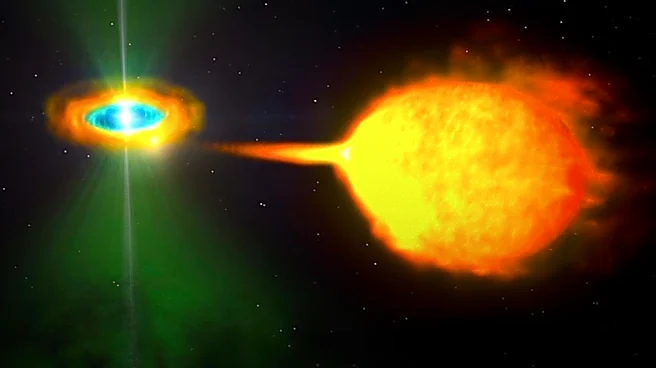
Scientists at the Curtin University node of the International Centre for Radio Astronomy Research (ICRAR) have identified a unique star system, GPM J071507−114153, that emits radio pulses every eight minutes. This system comprises a white dwarf, which
is the dense remnant of a dead star, orbiting a G-type star similar to our Sun. This discovery marks the first time radio pulses have been detected from a white dwarf in orbit with a Sun-like star; typically, such pulses are observed in systems involving smaller, cooler red dwarf stars. Lead author Dr. Sam McSweeney, a commissioning scientist with the Square Kilometre Array Observatory, confirmed that the pulsations originate from near or on the white dwarf itself, based on clear orbital movement. Associate Professor Natasha Hurley-Walker, a co-author, noted that these pulses allowed the team to detect stellar flares on the Sun-like star and observe a 'stellar prominence'—a large loop of plasma—as the white dwarf passed behind it. The detection involved extensive radio data processing from the Murchison Widefield Array (MWA) and MeerKAT radio telescope, with optical confirmation from the W.M. Keck Observatory.
Why It's Important?
This discovery significantly advances our understanding of long-period transients (LPTs), a class of objects that produce radio signals switching on and off over minutes to hours. By definitively linking the radio pulses to the white dwarf in this binary system, researchers gain crucial insights into the mechanisms behind these mysterious signals. The ability to detect stellar flares and prominences on a distant Sun-like star using radio wavelengths opens new avenues for studying stellar activity and magnetic fields across vast cosmic distances. This breakthrough challenges previous assumptions about the types of stellar companions involved in such systems and expands the potential environments where these phenomena can occur. The findings contribute to the broader field of astrophysics, pushing the boundaries of what can be observed and understood about stellar evolution and interactions.
What's Next?
The research team anticipates that the ongoing development and full deployment of the Square Kilometre Array Observatory (SKAO) telescopes, SKA-Low in Australia and SKA-Mid in South Africa, will lead to the discovery of many more such star systems. Dr. McSweeney expressed optimism that these advanced telescopes will provide a more detailed view of these signals, further enhancing our comprehension of LPTs. Future studies will likely focus on analyzing the precise characteristics of the radio pulses and their correlation with the white dwarf's properties and the Sun-like star's activity. This will involve continued data collection and processing, potentially leading to a more comprehensive model of how these unique binary systems generate and emit radio waves, and their implications for stellar physics.
Beyond the Headlines
The detection of GPM J071507−114153 highlights the power of advanced radio astronomy in uncovering previously unknown cosmic phenomena. The ability to observe stellar flares and plasma eruptions on a star over 5,000 light-years away through radio signals underscores the intricate interplay between different forms of electromagnetic radiation and their utility in astrophysical research. This discovery also touches upon the collaborative nature of modern science, involving multiple observatories and international research teams. The ongoing quest to understand LPTs and similar exotic star systems contributes to a deeper appreciation of the universe's complexity and the diverse evolutionary paths of stars, ultimately enriching humanity's cosmic perspective.