
What's Happening?
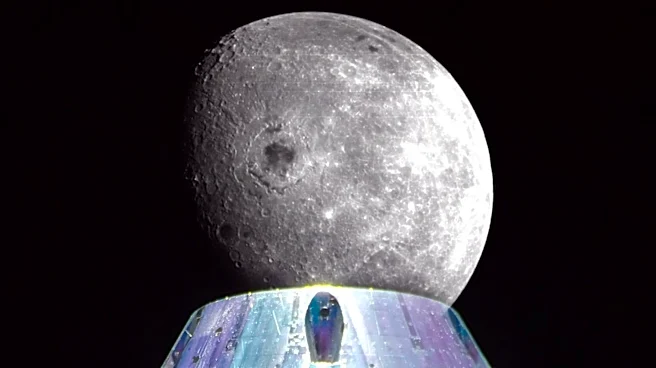
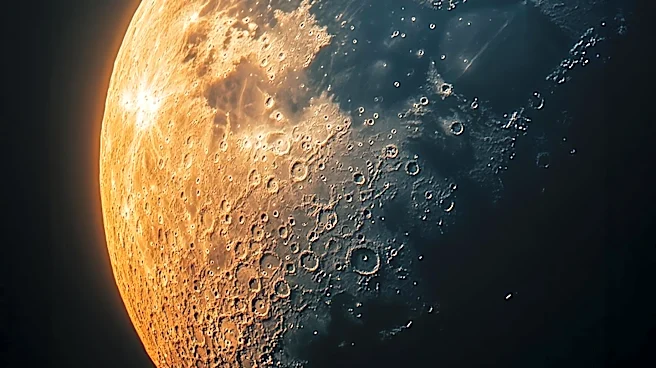
A recent study published in The Planetary Science Journal in October 2026 has revealed that the Moon's radius has shrunk by approximately 45 meters over the past 400 million years due to internal cooling
and contraction. This gradual shrinking process has led to the formation of over 10,000 young faults on the lunar surface, known as lobate scarps. These cliff-like landforms are created by compressional forces that cause the Moon's crust to wrinkle and break. Slippage along these lunar faults can generate moonquakes, which, unlike Earth's seismic activity concentrated at tectonic plate boundaries, can occur across the Moon's single-plate structure. NASA's Lunar Reconnaissance Orbiter Camera (LROC) has provided images crucial for studying these lunar surface features.
Why It's Important?
The ongoing contraction of the Moon and the resulting moonquakes have significant implications for future lunar missions, particularly those involving human exploration and the establishment of permanent bases. Understanding the frequency and intensity of moonquakes is crucial for designing stable and safe lunar habitats and infrastructure. The presence of numerous young faults suggests that the Moon is still geologically active, albeit in a different manner than Earth. For U.S. space agencies and private companies planning lunar ventures, this research provides vital data for risk assessment and engineering considerations. It also contributes to a deeper scientific understanding of planetary evolution and the internal dynamics of celestial bodies, informing broader astronomical and geological studies.
What's Next?
Further research will likely focus on precisely mapping the distribution and activity of these lunar faults and moonquakes. Data from missions like NASA's LROC will continue to be analyzed to refine models of lunar contraction and seismic activity. Future lunar missions, including those under the Artemis program, will need to incorporate these findings into their planning, potentially deploying more advanced seismometers and geological survey tools to monitor lunar seismic events. This ongoing study will be critical for ensuring the safety and success of long-duration human presence on the Moon, as well as for identifying potential resources or hazards associated with lunar geological processes.