


What's Happening?
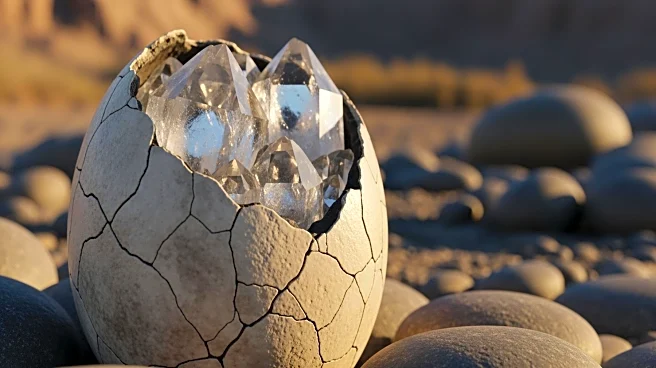
In eastern China, scientists have discovered two dinosaur eggs, each about five inches across, filled with mineral crystals instead of embryonic bones. Led by Qing He from Anhui University and the Nanjing Institute of Geology and Palaeontology, the research
team identified these eggs as a new oospecies, Shixingoolithus qianshanensis, based on their shell characteristics. The eggs, belonging to the Stalicoolithidae oofamily, were found to have thick shells and a dense pattern of microscopic columns. The discovery adds to the understanding of ornithopod reproduction, a group of plant-eating dinosaurs, and provides a snapshot of dinosaur life in the Qianshan Basin.
Why It's Important?
This discovery is significant as it expands the record of ornithopod reproduction in southern China, offering insights into how these dinosaurs laid and protected their eggs. The presence of mineral crystals within the eggs suggests unique geological processes that preserved these fossils, providing a rare glimpse into the reproductive strategies of dinosaurs. Such findings help paleontologists reconstruct ancient ecosystems and understand how dinosaurs adapted to their environments. The research also highlights the potential for further discoveries in regions with similar geological conditions, contributing to the broader understanding of dinosaur evolution and extinction.