


What's Happening?
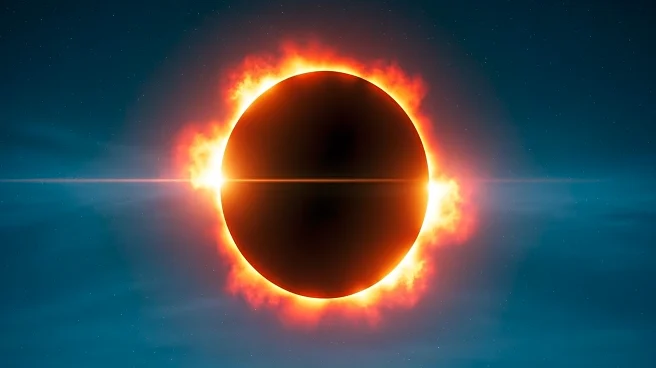
An annular solar eclipse is set to occur on February 17, 2026, creating a 'ring of fire' effect as the moon covers approximately 96% of the sun's disk. This celestial event will be visible primarily from a remote region of Antarctica, with partial views
available in parts of southern Africa and the southernmost regions of South America. The eclipse will begin at 4:56 a.m. EST, with the maximum eclipse occurring at 7:12 a.m. EST. An annular eclipse happens when the moon is farther from Earth in its elliptical orbit, appearing smaller than the sun and leaving a bright ring of sunlight encircling the moon. This phenomenon will be visible only within the path of annularity, a 2,661-mile-long and 383-mile-wide route. For those unable to witness the event in person, online livestreams and live blogs will be available to follow the eclipse.
Why It's Important?
The annular solar eclipse is significant as it offers a rare opportunity for scientific observation and public engagement with astronomy. Such events help increase public interest in space science and provide a platform for educational outreach. For scientists, eclipses offer a chance to study the sun's corona and other solar phenomena in detail. The event also highlights the importance of global cooperation in sharing observational data and resources, as the eclipse will be visible from remote and sparsely populated regions. Additionally, the eclipse serves as a reminder of the intricate dynamics of celestial bodies and their impact on Earth, fostering a deeper appreciation for the natural world.
What's Next?
As the eclipse approaches, preparations for observation and data collection are underway. Scientists and enthusiasts are likely to travel to the path of annularity to capture the event. Online platforms will provide live coverage, allowing a global audience to experience the eclipse virtually. In the aftermath, researchers will analyze data collected during the eclipse to gain insights into solar activity and its effects on Earth's atmosphere. The event may also inspire future astronomical studies and public interest in upcoming celestial events.