



What's Happening?
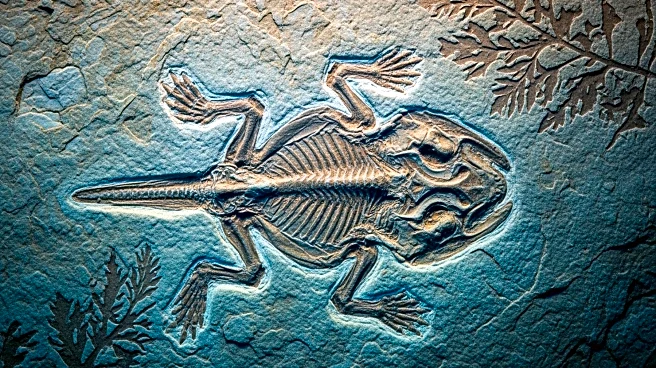
Fossils of ancient marine amphibians, initially discovered in Australia during the 1960s and 1970s, have been rediscovered and reassessed, revealing new insights into early marine ecosystems. These fossils, belonging to the trematosaurid temnospondyls,
were found in the Kimberly region of Western Australia and are among the oldest known Mesozoic marine tetrapods. The study, published in the Journal of Vertebrate Paleontology, highlights the diversity and global distribution of these early marine predators, which emerged shortly after the end-Permian mass extinction. The fossils, including species like Erythrobatrachus and Aphaneramma, indicate a rapid radiation into various ecological niches and a worldwide dispersal, possibly along the coastal margins of interconnected supercontinents.
Why It's Important?
The rediscovery and study of these fossils provide crucial information about the evolution of marine ecosystems following the end-Permian mass extinction, a pivotal event in Earth's history. Understanding the early diversification and global spread of marine tetrapods helps scientists piece together the evolutionary history of modern marine life. This research not only fills gaps in the fossil record, particularly in the Southern Hemisphere, but also enhances our understanding of how life on Earth adapted to past climate changes and mass extinction events. Such insights are vital for predicting how current and future environmental changes might impact biodiversity.
What's Next?
The rediscovered fossils are being repatriated to Australia, where they will be further studied and possibly displayed to the public. Continued research on these and other ancient fossils will likely focus on uncovering more about the ecological roles these early marine tetrapods played and how they interacted with their environment. This could involve advanced imaging techniques and comparative studies with other fossil records from around the world. The findings may also prompt new expeditions to uncover additional fossils in underexplored regions, potentially leading to more discoveries about early marine life.