






What's Happening?
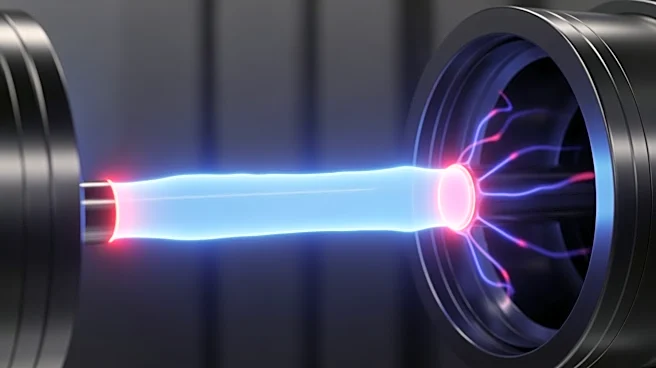
Researchers at the ELI Beamlines Facility and Czech Technical University in Prague have explored a new method for plasma-based particle accelerators. Their work focuses on using plasma waves driven by fast-moving beams of charged particles, such as protons
or electrons, to create a relativistic mirror. This concept, rooted in Einstein's theory of special relativity, could lead to the development of compact, ultrafast X-ray sources. The research, published in Physical Review E and Physical Review Research, suggests that these plasma waves could be used to reflect laser light, potentially revolutionizing particle physics experiments.
Why It's Important?
The development of plasma-based particle accelerators represents a significant advancement in the field of physics. These accelerators are smaller and more powerful than conventional ones, offering the potential for more efficient and cost-effective experiments. The ability to produce bright, coherent attosecond X-ray pulses could enhance research capabilities in various scientific fields, including materials science and medical imaging. This innovation could lead to new discoveries and applications, driving progress in technology and science.
What's Next?
The researchers plan to test their concept experimentally, using laser wakefield acceleration to produce the driving particle beam. Future research will focus on improving the efficiency of plasma-based relativistic mirrors and exploring new concepts to enhance their performance. The successful implementation of this technology could pave the way for the next generation of particle accelerators, with implications for scientific research and technological development.