







What's Happening?
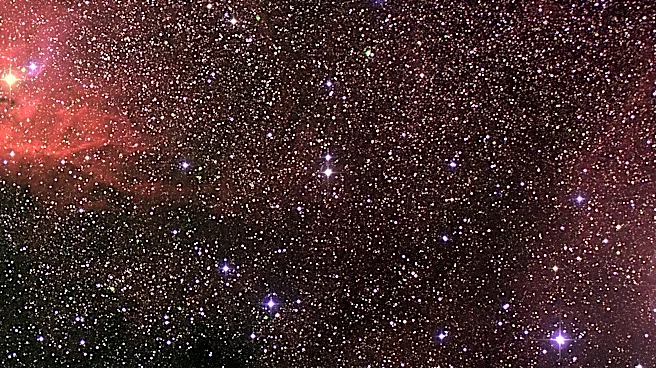
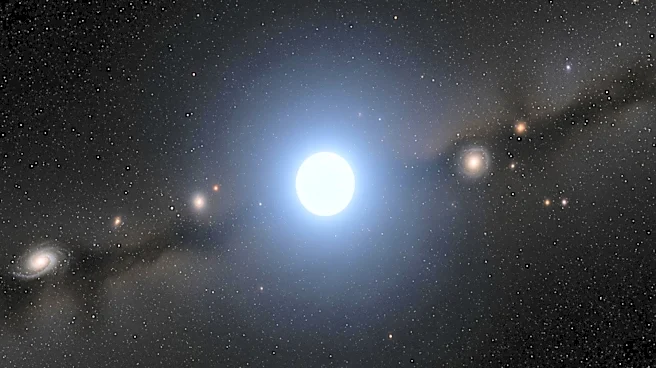
A group of students from the University of Chicago has discovered an ultra-ancient star, SDSS J0715-7334, within the Milky Way. This star is unique due to its minimal metal content, consisting mostly of hydrogen and helium. The discovery was made using
data from the Sloan Digital Sky Survey (SDSS), which helps scientists study the evolution of stars and galaxies. The star is believed to have originated in the Large Magellanic Cloud, a neighboring galaxy, and drifted into the Milky Way billions of years ago. This finding provides insight into the conditions of the early universe, as the star formed long before most supernovae, which are responsible for creating heavier elements.
Why It's Important?
The discovery of SDSS J0715-7334 is significant as it offers a glimpse into the early universe's conditions. The star's lack of heavy elements suggests it formed before the processes that create metals, such as supernovae. This finding challenges current understanding of stellar evolution and the formation of galaxies. It also highlights the potential for students to contribute to significant scientific discoveries, emphasizing the importance of collaborative projects like SDSS in advancing astronomical research. The star's journey from the Large Magellanic Cloud to the Milky Way provides valuable data on intergalactic movement and the history of our galaxy.