
What's Happening?
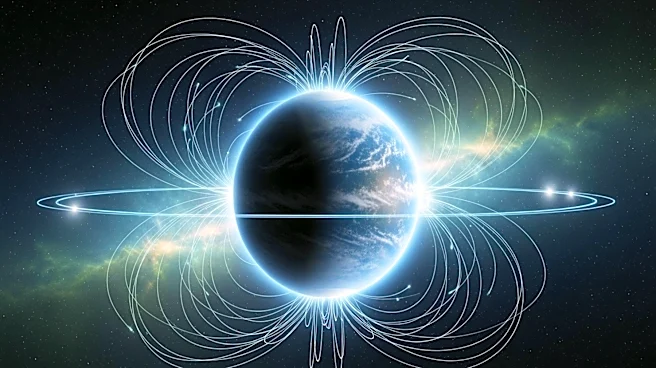
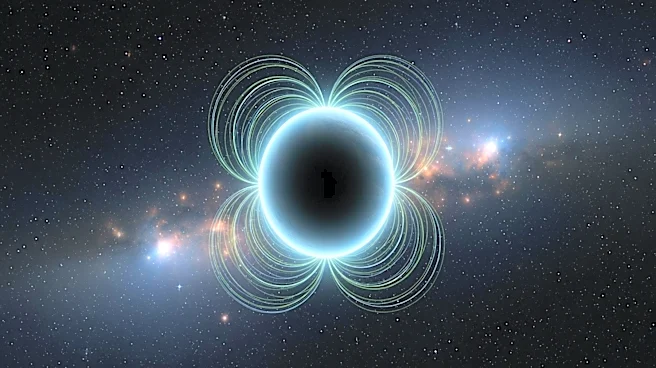
Researchers have used advanced simulations to explore the role of magnetic fields in the formation of binary star systems. The study, conducted with supercomputers like ATERUI III, revealed that magnetic fields can
draw protostars closer together by removing angular momentum, facilitating the formation of binary systems. This mechanism may also apply to massive binary black holes in gas-rich galactic centers, potentially explaining how they merge. The findings suggest that magnetic fields are crucial in the early stages of star and black hole formation.
Why It's Important?
Understanding the role of magnetic fields in star and black hole formation is vital for astrophysics, as it provides insights into the processes that shape galaxies. The ability of magnetic fields to influence the dynamics of protostars and black holes could have significant implications for models of galaxy evolution and the formation of supermassive black holes. This research highlights the complexity of cosmic interactions and the need for further studies to fully understand these phenomena.
What's Next?
Future research will focus on simulating the long-term evolution of massive binary black holes to better understand the influence of magnetic fields. Continued advancements in computational power and simulation techniques will be essential for exploring these complex systems. Further observational studies may also be conducted to validate the simulation results and refine models of star and black hole formation.