







What's Happening?
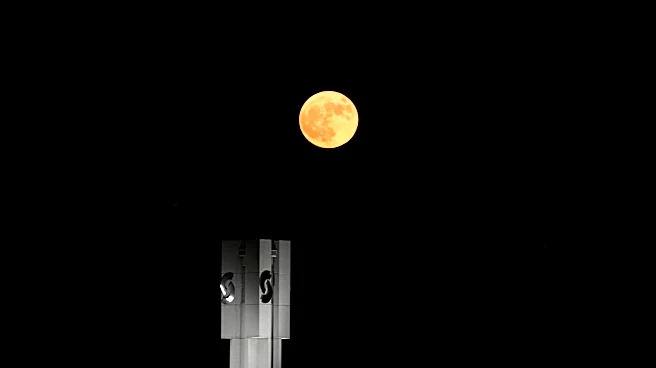
On July 29, 2026, the Full Buck Moon will rise shortly after sunset, dominating the night sky with its bright light. This astronomical event occurs when the moon is fully illuminated by the sun, making it difficult to observe fainter celestial objects.
The Full Buck Moon, named for the time when young male deer grow their antlers, will be visible in the constellation Capricornus. Despite the challenges posed by its brightness, the event offers an opportunity to observe the moon's large dark regions, known as maria, which are remnants of ancient lava flows. Observers are advised to use a moon filter or sunglasses to reduce glare when viewing through a telescope.
Why It's Important?
The Full Buck Moon is a significant event for astronomers and sky enthusiasts, as it provides a unique opportunity to study the moon's surface features. The bright illumination allows for the observation of the moon's maria and other geological features, offering insights into its volcanic history. This event also highlights the challenges of lunar observation during a full moon, as the lack of shadows makes it difficult to discern details. The Full Buck Moon's prominence in the sky can also impact other astronomical observations, as its brightness can obscure fainter stars and celestial objects.
What's Next?
Following the Full Buck Moon, sky watchers can look forward to observing other celestial events, such as the appearance of Mercury and other planets. The moon's brightness will gradually wane, allowing for better visibility of stars and deep-sky objects in the coming days. Astronomers and enthusiasts will continue to monitor the moon's phases and plan observations around its cycle to maximize visibility of various celestial phenomena.