
What's Happening?
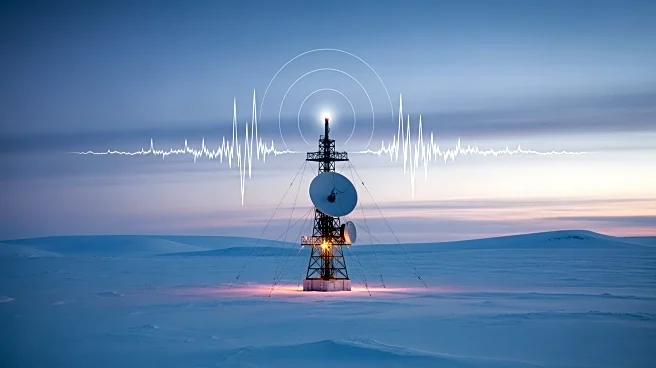
The Antarctic Impulsive Transient Antenna (ANITA) experiment has detected a series of unexplained radio signals originating from beneath Antarctica's ice. These signals, observed between 2016 and 2018,
defy current models of particle physics, suggesting the presence of unknown particles or interactions. The signals' steep angles and energy levels do not align with known neutrino behavior, leading scientists to consider alternative explanations, including potential links to dark matter.
Why It's Important?
The discovery of these anomalous signals could have profound implications for particle physics and our understanding of the universe. If linked to dark matter, it would represent a major breakthrough, potentially revealing new interactions between dark and normal matter. This could significantly alter current scientific models and open new research avenues in fundamental physics.
What's Next?
To further investigate these signals, scientists are developing the Payload for Ultrahigh Energy Observations (PUEO) experiment, an advanced version of ANITA. PUEO aims to improve detection capabilities and provide clearer insights into the signals' origins. The ongoing research in Antarctica continues to push the boundaries of physics, with the potential to uncover new phenomena or particles.