




What's Happening?
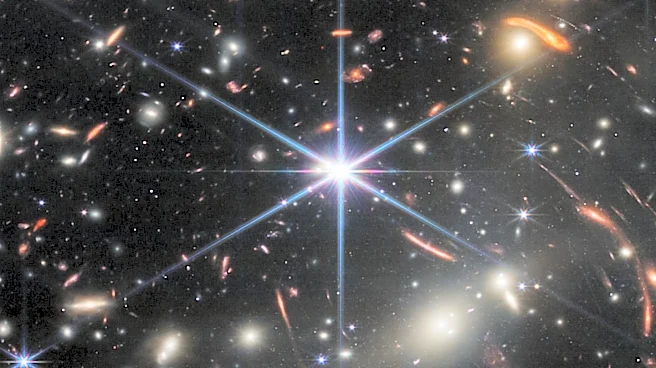
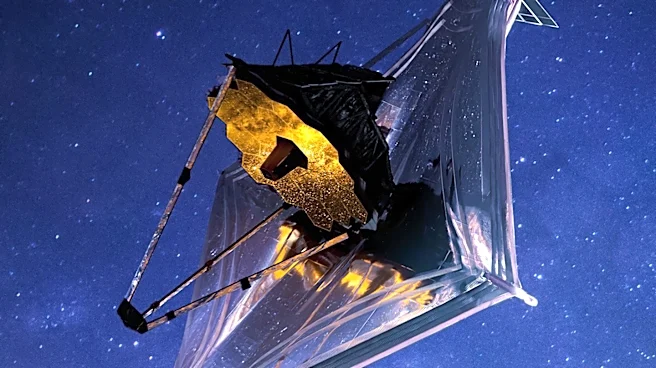
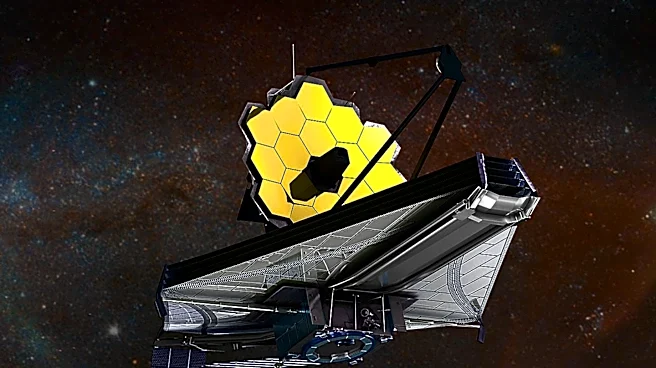
The James Webb Space Telescope (JWST) has detected an exceptionally luminous object, designated MoM-BH-1, from approximately 660 million years after the Big Bang. This object exhibits a luminosity roughly 100 billion times that of the Sun, far exceeding
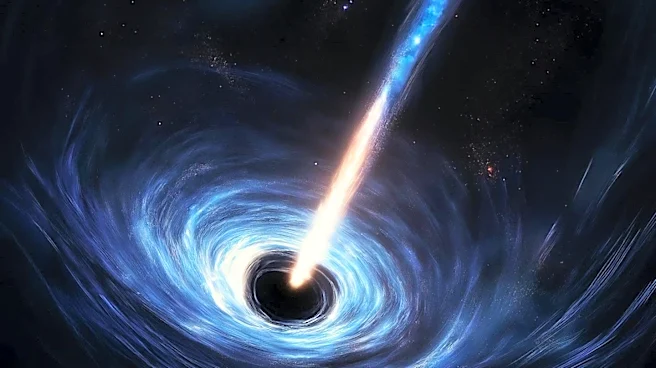
what can be explained by normal stellar fusion. Scientists propose that MoM-BH-1 is a growing black hole encased within an extraordinarily dense, almost dust-free hydrogen envelope, spanning a size comparable to our Solar System. The JWST's observations, including a 4.5-hour NIRSpec prism observation and an earlier 1.5-hour, higher-resolution spectrum, revealed a significant Balmer break and hydrogen-beta emission, which are difficult to reconcile with typical stellar populations. The 'star-like' appearance refers to the escaping light, which combines a blackbody-like continuum with absorption features usually associated with stellar atmospheres, rather than a fusion-powered star. The energy source is attributed to gas falling into the black hole, converting gravitational energy into radiation, with the surrounding hydrogen reshaping this power before it is emitted.
Why It's Important?
This discovery is crucial for understanding the formation and evolution of supermassive black holes in the early universe. The existence of such a luminous object so soon after the Big Bang challenges current models of black hole growth, as there is limited time for them to reach such immense sizes. The proposed dense hydrogen envelope around the black hole offers a potential mechanism for rapid growth, as it could feed the black hole while trapping or redistributing radiation that would otherwise impede inflow. This finding could lead to a re-evaluation of cosmological models and the conditions prevalent in the nascent universe. For astrophysics, it provides a new class of objects to study, potentially bridging the gap between early 'seed' black holes and the supermassive black holes observed in mature galaxies. The U.S. scientific community, particularly NASA and institutions involved with the JWST, plays a leading role in these discoveries, pushing the boundaries of our understanding of cosmic origins.
What's Next?
Further observations and theoretical modeling will be essential to confirm the nature of MoM-BH-1 and similar objects. Scientists will likely seek additional spectroscopic data to refine the physical parameters of the hydrogen envelope and the central black hole. The current model, while providing the 'best explanation,' is acknowledged to be simple and idealized, suggesting that more complex simulations are needed to fully explore the parameter space and rule out alternative exotic scenarios, such as supermassive metal-free stars. The ongoing research will focus on understanding how such dense hydrogen envelopes could form and sustain rapid black hole accretion in the early universe. The implications of this discovery will continue to be explored by astronomers and cosmologists, potentially leading to new theories about the co-evolution of galaxies and their central black holes.
Beyond the Headlines
The discovery of MoM-BH-1 delves into the fundamental questions of cosmic existence and the origins of structure in the universe. It highlights the power of advanced observational tools like the JWST to reveal phenomena that challenge established scientific paradigms. The concept of a 'black hole star'—a black hole masquerading as a star due to its surrounding gas envelope—blurs the lines between different celestial classifications and encourages a more nuanced understanding of cosmic objects. This finding also underscores the dynamic and often counter-intuitive nature of the early universe, where extreme conditions led to the formation of structures that are vastly different from what we observe today. Philosophically, it pushes the boundaries of human comprehension regarding the universe's vastness and complexity, reminding us that our current models are always subject to refinement and revision based on new empirical evidence.