







What's Happening?
China is preparing to launch its Chang'e-7 mission, a complex multi-spacecraft endeavor aimed at studying and landing near the lunar south pole. The mission, set for launch around August 23, 2026, from Wenchang Satellite Launch Center, will utilize a Long
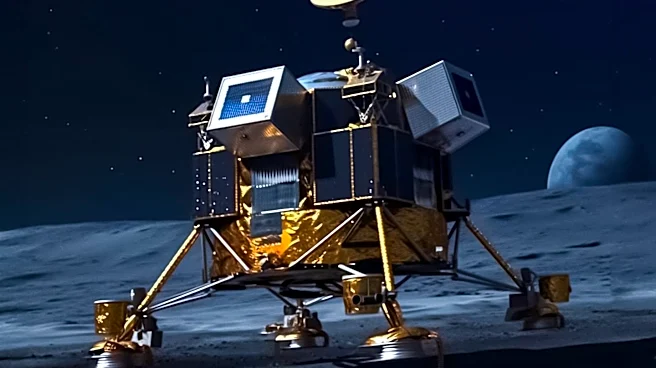
March 5 rocket. The Chang'e-7 stack includes an orbiter, lander, rover, and a hopper spacecraft. Its primary objective is to search for evidence of water-ice and other volatiles in permanently shadowed craters near the lunar south pole. The lander will attempt a precise landing near the Peak Near Shackleton, a feature close to the Shackleton crater, seeking areas with extended solar illumination and access to shadowed regions. The hopper spacecraft is designed to make multiple flights into shadowed craters, using a Lunar soil Water molecule Analyser (LUWA) to scan for surface frost and a drill to retrieve subsurface soil samples for analysis.
Why It's Important?
The Chang'e-7 mission holds significant implications for future lunar exploration and resource utilization, which could impact U.S. space policy and international collaborations. The discovery and characterization of water-ice at the lunar south pole are crucial for establishing long-term human presence on the Moon, as water can be used for drinking, oxygen production, and rocket fuel. China's successful execution of this mission would solidify its position as a leading space power, potentially influencing the global space race and competition for lunar resources. The mission's technical groundwork for the International Lunar Research Station (ILRS), planned with Russia, presents a potential alternative to U.S.-led initiatives like the Artemis Accords. This could lead to increased geopolitical competition in space, affecting U.S. efforts to establish international norms and partnerships for lunar exploration. The advanced technologies employed, such as the precision landing and the hopper's ability to explore shadowed craters, could also push the boundaries of lunar science and engineering, prompting other nations to accelerate their own lunar programs.
What's Next?
Following its launch, the Chang'e-7 stack will enter an initial lunar orbit approximately five days later. The orbiter will then begin imaging potential landing sites near the lunar south pole, with the exact landing date yet to be announced, potentially occurring months after orbital insertion. The mission's success will depend on the precise landing of the lander and the effective operation of the rover and hopper in the challenging lunar south pole environment. Data collected by Chang'e-7, particularly regarding the presence and characteristics of water-ice, will inform the subsequent Chang'e-8 mission, planned for around 2029, which focuses on in-situ resource utilization. The findings will also be compared with data from other international missions, such as NASA's VIPER rover, expected to explore the same region. The outcomes of Chang'e-7 will likely influence future international collaborations and competitive strategies in lunar exploration.
Beyond the Headlines
Beyond the immediate scientific and technological achievements, the Chang'e-7 mission carries broader implications for humanity's long-term presence in space. The potential for extracting and utilizing lunar resources, particularly water, could transform space exploration from costly, Earth-dependent ventures into more sustainable, self-sufficient endeavors. This mission highlights the growing trend of nations investing heavily in space exploration not just for scientific discovery, but also for strategic and economic advantages. The development of technologies for operating in extreme lunar environments, such as permanently shadowed regions, could also have spin-off benefits for terrestrial applications in harsh conditions. Furthermore, the mission's contribution to the ILRS project underscores the emergence of new international partnerships in space, challenging traditional alliances and potentially reshaping the governance and access to extraterrestrial resources. The ethical considerations surrounding resource ownership and environmental protection on celestial bodies will become increasingly prominent as such missions progress.