







What's Happening?
Yale-led researchers have developed a novel computational approach that allows for the reconstruction of genetic relationships of extinct species from highly degraded and fragmented DNA samples. This new method addresses the long-standing challenge in evolutionary
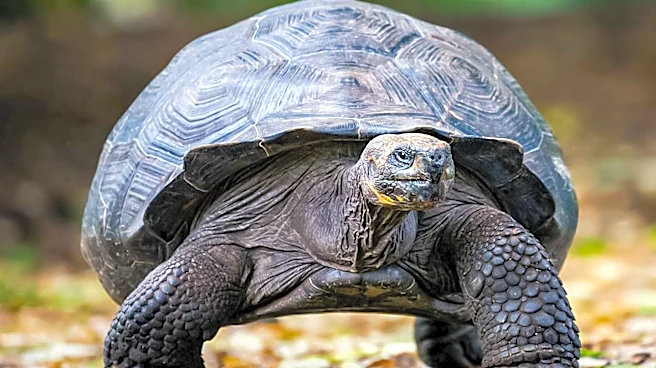
research of unlocking DNA from ancient samples, which often contain only scattered genetic fragments. The study, co-authored by Alexander Ochoa and Adalgisa Caccone of Yale’s Department of Ecology and Evolutionary Biology, focused on Galapagos giant tortoises. Researchers extracted DNA from dried bones of historical museum specimens, including five from two extinct tortoise lineages. They then combined these genetic scraps and superimposed them onto a reference phylogenetic tree built from high-quality genomes of living and other historical tortoises. This approach successfully identified specimens from the extinct San Cristóbal and Santa Fe island lineages, even when less than 1% of the genome could be read from some degraded samples, which would typically be discarded in conventional genomic analyses due to potential distortions in evolutionary relationships.
Why It's Important?
This breakthrough is significant for conservation efforts and understanding evolutionary history. By enabling researchers to glean maximum insights from degraded genetic material, the new computational toolkit can help link past and present lineages, which is crucial for current conservation strategies across the Galapagos archipelago. Historically, human-driven migration events, such as sailors transporting tortoises between islands, led to interbreeding. This means that the genomes of extinct lineages may still persist within extant, hybrid tortoises. The ability to identify these genetic remnants provides a deeper understanding of biodiversity and the impact of historical events on species. This method could also be applied to other extinct species, offering new avenues for studying evolutionary biology and informing conservation practices for endangered populations by revealing hidden genetic diversity and ancestral traits.
What's Next?
The immediate next steps involve further application and refinement of this computational approach. Researchers may seek to apply this toolkit to a wider range of degraded samples from various extinct species to validate its versatility and robustness. This could lead to a re-evaluation of museum collections, potentially uncovering new genetic information from specimens previously deemed unusable. The findings could also influence conservation strategies by providing a more complete genetic picture of extant populations, helping to identify valuable genetic diversity inherited from extinct ancestors. Future research might also focus on integrating this computational method with other advanced genomic techniques to enhance the accuracy and scope of genetic reconstructions, potentially leading to a more comprehensive understanding of evolutionary pathways and biodiversity.
Beyond the Headlines
Beyond its immediate scientific implications, this research highlights the enduring value of historical museum collections. Specimens that were once considered too degraded for meaningful genetic analysis can now become invaluable sources of information, underscoring the importance of preserving such biological archives. Ethically, the ability to reconstruct the genetic past raises questions about the potential for de-extinction efforts, though the current focus remains on understanding evolutionary relationships and informing conservation. Culturally, this work deepens our appreciation for the intricate history of life on Earth and the impact of human activities on ecosystems. It also showcases the power of interdisciplinary approaches, combining biology with advanced computational science, to solve complex scientific challenges and push the boundaries of what is possible in genetic research.