




What's Happening?
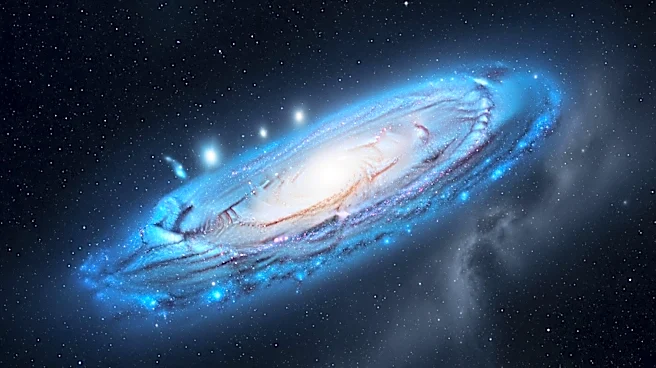
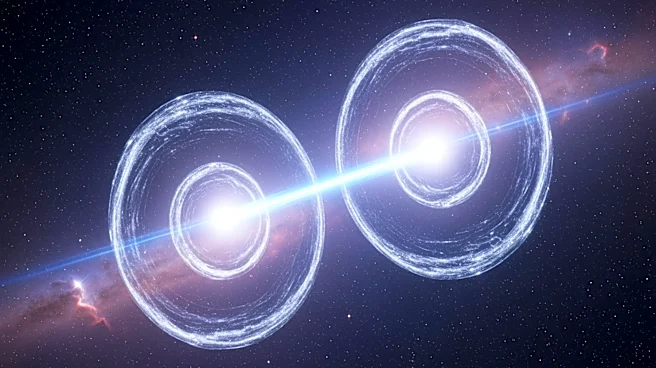
Astronomers have identified the most distant and powerful 'space laser' ever detected, originating from galaxies that collided approximately 8 billion light-years away. This discovery was made using the MeerKAT radio telescope in South Africa, which detected a hydroxyl
megamaser—a type of natural space laser that emits energy in the form of radio waves rather than visible light. The signal is from a galaxy system known as HATLAS J142935.3-002836, and its detection was facilitated by gravitational lensing, a process where the gravity of massive objects magnifies light from distant sources. This magnification made the signal brighter and easier to detect, allowing scientists to study a system that would otherwise be too faint to observe.
Why It's Important?
The detection of this space laser is significant as it provides insights into the conditions and processes occurring in the early universe. By studying such distant signals, researchers can better understand how galaxies merge and create dense gas regions that amplify cosmic signals. The presence of this megamaser indicates strong activity within the merging galaxies, including large amounts of dense gas. This discovery contributes to the broader understanding of cosmic evolution and the mechanisms that drive galaxy formation and interaction over vast distances and time scales.
What's Next?
The study detailing this discovery has been accepted for publication in a scientific journal, offering early access to the findings. Researchers will continue to analyze the data to gain further insights into the conditions that lead to the formation of such powerful megamasers. Future observations may focus on identifying more distant signals and understanding the role of gravitational lensing in detecting faint cosmic phenomena. This could lead to advancements in the study of galaxy evolution and the dynamics of the early universe.
Beyond the Headlines
The discovery of this space laser highlights the importance of advanced telescopes and observational techniques in uncovering hidden aspects of the universe. Gravitational lensing, in particular, serves as a natural magnifying tool, enabling astronomers to study phenomena that would otherwise remain undetected. This underscores the potential for future technological advancements to further expand our understanding of the cosmos and the intricate processes that govern it.