







What's Happening?
A new study by astrophysicists at the University of Lancashire suggests that planets may form more easily around binary stars than single stars. The research indicates that binary star systems, which are common in our galaxy, can create dynamic environments
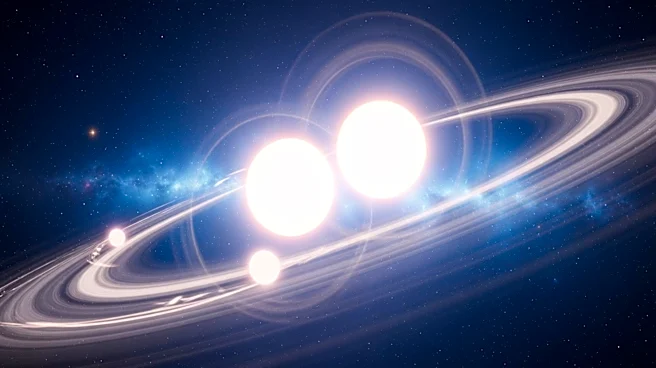
conducive to planet formation. Using advanced computer simulations, scientists found that the inner regions of gas disks around binary stars form a 'forbidden zone' where strong gravitational effects prevent planet formation. However, outside this zone, the disks can collapse under their own gravity, leading to the formation of giant planets. This challenges previous assumptions that binary stars were hostile to planet formation.
Why It's Important?
The findings could significantly impact our understanding of planet formation and the prevalence of planets in the universe. If binary star systems are indeed more conducive to planet formation, it could mean that planets are more common than previously thought. This has implications for the search for extraterrestrial life and the study of planetary systems. The research also opens up new possibilities for future observations using advanced telescopes, potentially leading to the discovery of more exoplanets.
What's Next?
The study suggests that future observations using facilities like the ALMA, James Webb Space Telescope, and the Extremely Large Telescope could further explore these findings. Researchers may focus on identifying and studying planets in binary star systems to better understand their formation and characteristics. This could lead to a reevaluation of current models of planet formation and influence future astronomical research priorities.