



What's Happening?
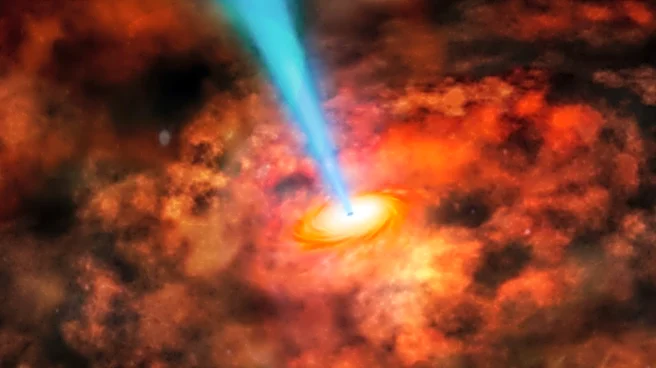
A team of Polish and German scientists has conducted a long-term study of blazars, active galaxies that emit jets of matter toward Earth. The research focused on the blazar PKS 2155-304, located 1.5 billion light-years away. Despite two decades of observations,
the study has raised more questions than answers about the nature of blazars. These galaxies exhibit high variability in their radiation across a wide energy range, making them difficult to study. The research suggests that current models, which assume radiation is emitted from a single jet zone, may not fully explain the complex behaviors observed in blazars.
Why It's Important?
Understanding blazars is crucial for astrophysics as they may be sources of high-energy cosmic neutrinos, particles that are challenging to detect but provide insights into the universe's most energetic processes. The study's findings challenge existing models and highlight the need for more comprehensive observations across the electromagnetic spectrum. This research could lead to new theories about the mechanisms driving blazar activity and their role in cosmic phenomena. The potential link between blazars and neutrino production also has implications for particle physics and our understanding of the universe's fundamental forces.
What's Next?
Future research will likely focus on developing more sophisticated models to explain blazar behavior. Continuous monitoring with advanced instruments capable of detecting a broad range of electromagnetic radiation is necessary to capture the full complexity of these objects. Collaborative efforts between international research teams and the use of cutting-edge technology will be essential in unraveling the mysteries of blazars. The findings may also prompt further investigation into the potential connection between blazars and cosmic neutrinos, offering new avenues for exploration in both astrophysics and particle physics.