






What's Happening?
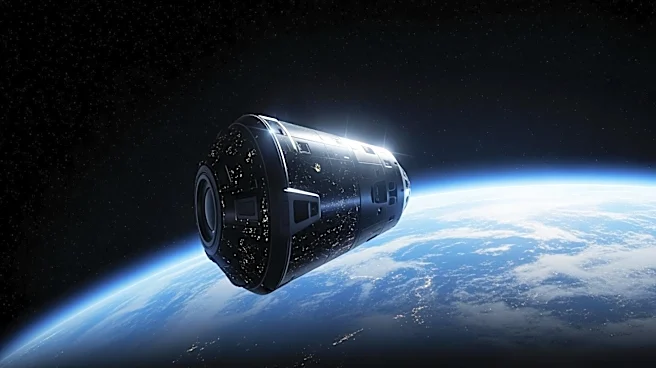
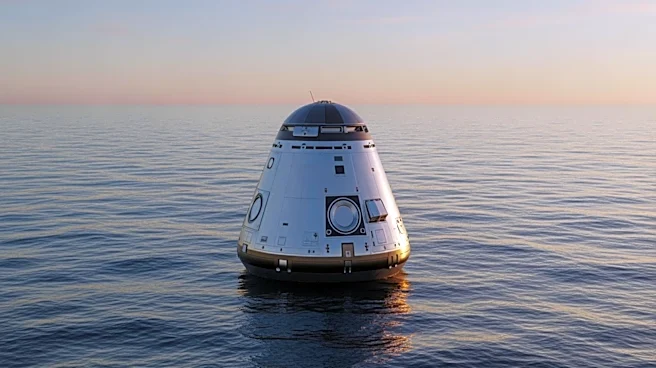
Lockheed Martin's Orion spacecraft has successfully completed NASA's Artemis II mission, marking a significant milestone in deep space exploration. After a 10-day journey around the Moon, the spacecraft, carrying a four-person crew, re-entered Earth's
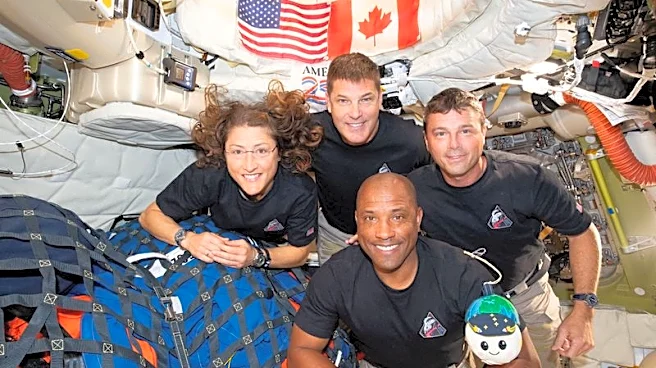
atmosphere at speeds nearing 24,000 mph and safely splashed down in the Pacific Ocean off the coast of southern California. This mission demonstrated Orion's capability to transport astronauts beyond low-Earth orbit and return them safely, a crucial step for future Artemis missions. The crew, consisting of astronauts Reid Wiseman, Victor Glover, Christina Koch, and Canadian Space Agency astronaut Jeremy Hansen, conducted system evaluations and captured scientific data during their journey, setting a record for the farthest human spaceflight from Earth at 252,756 miles.
Why It's Important?
The successful completion of the Artemis II mission is pivotal for NASA's plans to return humans to the Moon and eventually explore Mars. Orion's performance validates its design and capabilities, ensuring that future missions can safely transport astronauts to and from deep space. This mission also provides critical data that will refine systems and operations for upcoming missions, including Artemis III and IV, which aim to land astronauts on the lunar surface. The advancements in space exploration technology demonstrated by Lockheed Martin and NASA are essential for maintaining U.S. leadership in space exploration and fostering international collaboration in scientific discovery.
What's Next?
Following the successful splashdown, the crew will undergo post-mission medical evaluations before returning to NASA's Johnson Space Center in Houston. The data collected during the mission will be analyzed to improve systems for future Artemis missions. Lockheed Martin, as the prime contractor for the Orion spacecraft, will continue to work with NASA to enable sustainable lunar exploration and support long-term goals for human exploration of Mars. The next steps include preparing for Artemis III, which will demonstrate critical docking with NASA's Human Landing System, and Artemis IV, which aims to land astronauts on the Moon.
Beyond the Headlines
The Artemis II mission not only advances technological capabilities but also represents a significant cultural and scientific achievement. It rekindles public interest in space exploration and inspires future generations to pursue careers in science and technology. The mission underscores the importance of international collaboration, as demonstrated by the inclusion of a Canadian astronaut, which could lead to more cooperative efforts in space exploration. Additionally, the mission's success may influence policy decisions regarding funding and support for NASA's long-term exploration goals.