






What's Happening?
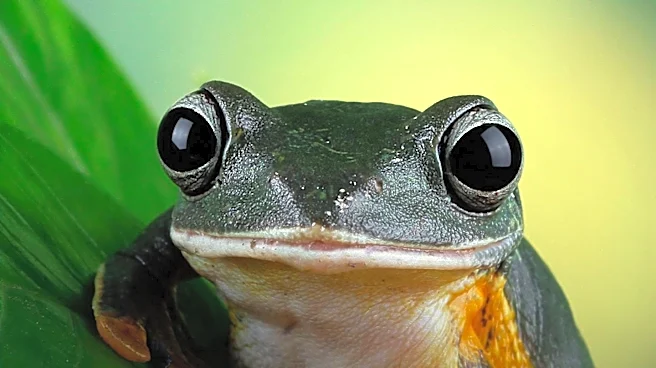
A new study on Cope's gray tree frogs in Tennessee reveals that female frogs make suboptimal mating choices when presented with too many options. Researchers tested 60 female frogs in a sound chamber, offering either two, four, or eight recorded mating calls.
Females typically prefer longer calls, which are linked to better survival odds for offspring. When only two calls were available, 77% of the frogs chose the longer, more desirable call. However, this percentage dropped to about half with four options and to only one in five when eight calls were presented. The study, published in iScience, also noted that decision-making time increased, and 17% of frogs confronted with eight calls made no choice at all.
Why It's Important?
This research is important because it demonstrates the phenomenon of 'choice overload' in a non-human species, specifically impacting reproductive success. For Cope's gray tree frogs, making the 'best' mating choice directly influences the genetic fitness and survival of their offspring. The findings suggest that environmental factors, such as the density and variety of available mates, can significantly impair an individual's ability to make optimal decisions, even for fundamental biological processes. This could have broader ecological implications, potentially explaining how less impressive males manage to contribute to the gene pool, thereby affecting population genetics and evolutionary trajectories. Understanding these dynamics can provide insights into how environmental complexity influences animal behavior and population health.
What's Next?
Future research could explore the specific neurological or physiological mechanisms behind 'choice overload' in these frogs, investigating how their sensory processing and decision-making pathways are affected by an increased number of stimuli. Scientists might also examine whether similar 'choice overload' effects are present in other species, particularly those with complex mating rituals or environments. Additionally, studies could investigate the long-term evolutionary consequences of such suboptimal mating choices on frog populations, including potential impacts on genetic diversity and adaptation to changing environments. Understanding these mechanisms could offer broader insights into decision-making processes across the animal kingdom and the ecological pressures that shape them.
Beyond the Headlines
The study's findings on 'choice overload' in Cope's gray tree frogs offer a fascinating parallel to human decision-making, where an abundance of options can often lead to indecision or suboptimal choices. This phenomenon, often observed in consumer behavior or complex social situations, appears to have deep biological roots. It suggests that cognitive limitations in processing extensive information are not unique to humans but are a fundamental aspect of decision-making across species. This research could contribute to a broader understanding of cognitive load and its impact on behavior, highlighting how even seemingly simple organisms can be overwhelmed by too many choices. It also subtly challenges the assumption that more options always lead to better outcomes, suggesting that there's an optimal level of choice beyond which efficiency and quality of decision-making decline.