






What's Happening?
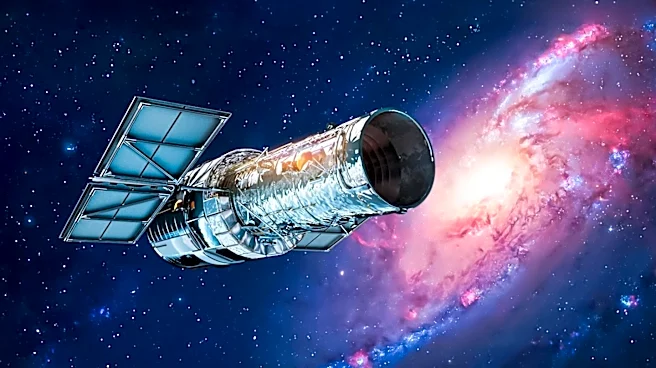
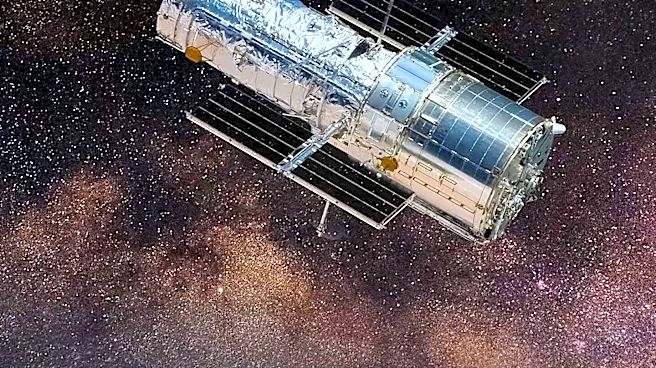
The NASA/ESA Hubble Space Telescope has conducted new observations of Messier 30, a globular cluster located approximately 27,500 light-years away in the southern constellation of Capricornus. This cluster, also known as M30, NGC 7099, or the Jellyfish
Cluster, contains some of the oldest stars in the Milky Way Galaxy. These observations aim to provide clues about how these ancient stellar populations formed and evolved, and to investigate whether some of them originated outside our home galaxy. Globular clusters like Messier 30 are considered 'time capsules' that preserve the original chemistry of the young Milky Way. However, the fact that Messier 30 and many other globular clusters orbit in the opposite direction to the Milky Way's spin suggests they might have been captured by our galaxy in the distant past rather than forming within it.
Why It's Important?
The study of Messier 30 is crucial for understanding the formation and evolutionary history of the Milky Way. By examining the ancient stars within this globular cluster, astronomers can gain insights into the conditions and chemical composition of the early universe. The potential for Messier 30 to be an 'extragalactic' immigrant provides evidence for galactic mergers and accretion events that shaped the Milky Way over billions of years. This research helps to refine our models of galaxy formation and evolution, shedding light on how large spiral galaxies like ours assemble their stellar populations. Understanding the origins of globular clusters contributes to a more complete picture of the cosmic landscape and the dynamic processes that govern it.
What's Next?
Astronomers will continue to analyze the data from Hubble's observations of Messier 30 to determine the precise chemical compositions and ages of its stars. This will help to confirm or refute the hypothesis that the cluster originated outside the Milky Way. Further studies may involve comparing Messier 30's characteristics with other globular clusters to identify common patterns among those believed to be accreted. The insights gained from this research will inform future observational campaigns using advanced telescopes, potentially leading to a more detailed understanding of the Milky Way's assembly history and the role of globular clusters as tracers of galactic evolution.
Beyond the Headlines
The investigation into Messier 30's origins touches upon the broader concept of galactic cannibalism, where larger galaxies absorb smaller ones. This process is a fundamental aspect of galaxy evolution, and studying clusters like Messier 30 provides direct evidence of these ancient cosmic events. The idea that some of the oldest stars in our galaxy might have originated elsewhere challenges the notion of a singular, isolated formation for the Milky Way, instead painting a picture of a dynamic and constantly evolving system. This research also highlights the enduring legacy of astronomers like Harlow Shapley, whose early work with globular clusters revolutionized our understanding of the Sun's position within the galaxy, demonstrating the long-term impact of astronomical observations on our cosmic perspective.