






What's Happening?
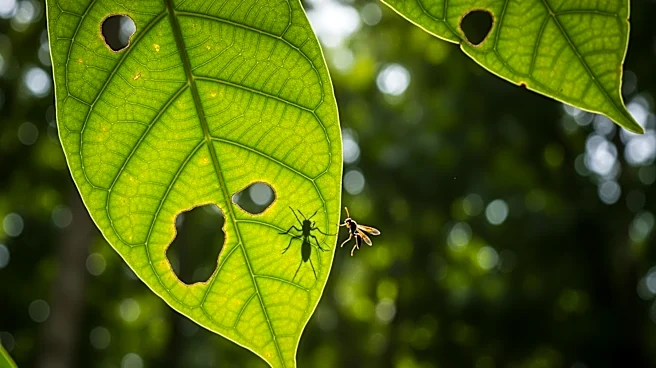
An international team of scientists has discovered that predatory wasps are disrupting a long-standing mutualistic relationship between ants and the Macaranga pearsonii plant in Malaysian Borneo. The study, published in PeerJ, reveals that these wasps are taking
over the hollow stems of the plant, which were originally evolved to house protective ant colonies. This mutualism, which has thrived for over 10 million years, involves the plant providing shelter and food to ants, which in return protect the plant from herbivores. However, the wasps are now using these plant structures to store paralyzed flies as food for their larvae, significantly reducing the ant populations in these plants. The research indicates that human-driven habitat changes, such as logging and oil palm plantations, may be facilitating the spread of these wasps.
Why It's Important?
The disruption of this ancient mutualism could have significant ecological consequences. The Macaranga species are crucial for forest regeneration, especially in disturbed areas. If the plants lose their ant defenders, they may become less healthy, potentially hindering forest recovery. This situation highlights the broader impact of human activities on ecological relationships and biodiversity. The study suggests that such disruptions could lead to long-term evolutionary changes, as plants may stop investing in structures that are no longer beneficial. This case serves as a warning of how subtle ecological interactions can unravel due to human influence, potentially leading to shifts in species dominance and weakened natural defenses in plants.
What's Next?
Further research is needed to understand the full impact of wasp colonization on the ant-plant mutualism and forest ecosystems. Scientists may conduct experiments to determine if the wasps are displacing the ants entirely and to explore the potential evolutionary changes in the plants. Monitoring the spread of these wasps and their impact on other mutualistic relationships in tropical ecosystems could provide insights into the broader implications of human-driven habitat changes.
Beyond the Headlines
This study underscores the complexity of ecological interactions and the potential for human activities to disrupt them in unexpected ways. The breakdown of mutualistic relationships can lead to cascading effects on biodiversity and ecosystem stability. Understanding these dynamics is crucial for conservation efforts and for predicting how ecosystems might respond to ongoing environmental changes.