







What's Happening?
The Greater Cleveland Regional Transit Authority (GCRTA) is exploring the development of a new light-rail station near the future Cleveland Browns Stadium in Brook Park. This proposed 'Browns Stadium Station' was recently added to the Ohio Department
of Transportation’s (ODOT) online project management database, 'Ellis,' indicating active pursuit of funding or movement into development. The project, estimated at $30 million, includes $26.75 million for construction and $3.25 million for design and administrative work, with an anticipated construction start date in the first quarter of 2028. Despite its inclusion in the ODOT database, officials from ODOT and the Northeast Ohio Areawide Coordinating Agency (NOACA) have stated they are currently unaware of the project's specifics or funding proposals. Haslam Sports Group (HSG), which initially proposed the station as part of their new Huntington Bank Field complex, declined to comment. The City of Brook Park did secure a $1 million grant from the U.S. Department of Transportation’s Innovative Finance and Asset Concession (IFAC) program in June, which can be used for design related to major projects near the Red Line, including the new stadium and the Cleveland Hopkins International Airport modernization.
Why It's Important?
The potential development of the Browns Stadium Station is significant for addressing transportation challenges associated with the new Huntington Bank Field. With concerns about limited stadium parking, a dedicated rapid transit station on a high-frequency line could alleviate traffic congestion and parking issues in surrounding areas. This would provide a convenient alternative for thousands of attendees, similar to how the Waterfront Line currently serves downtown Cleveland events. Furthermore, integrating the station into GCRTA's daily operations, rather than an event-only basis, has the potential to boost overall rail ridership and simplify transit for the public. The project's advancement, despite initial communication gaps among key stakeholders, highlights the ongoing efforts to enhance public infrastructure to support major economic developments and improve urban mobility in Northeast Ohio. The IFAC grant secured by Brook Park underscores federal interest in innovative financing for critical transportation infrastructure.
What's Next?
The immediate next steps involve clarifying the funding sources and project ownership for the Browns Stadium Station. While GCRTA is named as the sponsoring agency in ODOT's database, suggesting a local or private funding model, the lack of awareness from ODOT and NOACA indicates a need for greater coordination among stakeholders. GCRTA's General Manager and CEO, India Birdsong Terry, has previously expressed a proactive approach to working with HSG developers, suggesting potential for increased Red Line frequency and capacity for stadium events. The new unified railcar fleet, set to enter service on the Red Line in Summer 2027 and Green/Blue lines in Summer 2028, could support more frequent trains. However, it remains uncertain if the new station will be fully operational by the Browns' planned stadium opening in May 2029, which could impact initial event logistics. Further discussions and formal agreements between GCRTA, HSG, ODOT, and NOACA will be crucial to move the project forward.
Beyond the Headlines
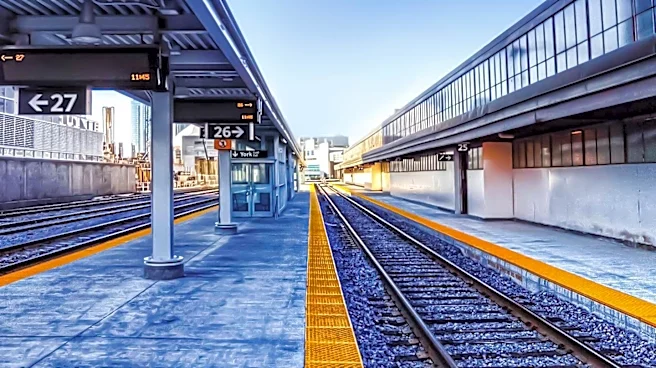
The ambiguity surrounding the Browns Stadium Station project, despite its inclusion in a state database, points to potential complexities in large-scale public-private partnerships and infrastructure development. The disconnect between the project's official listing and the awareness of key agencies could indicate challenges in inter-agency communication or the early stages of funding acquisition. This situation also highlights the broader trend of leveraging major sports and entertainment venues as catalysts for urban development and public transit improvements. The station's design, featuring a center-island platform and a pedestrian bridge connecting to the stadium, reflects modern urban planning efforts to integrate transit with large public spaces. The success of this project could serve as a model for other U.S. cities looking to enhance accessibility to their sports and entertainment districts, while its current uncertainties underscore the intricate process of securing funding and coordinating diverse stakeholders for such ambitious undertakings.