
What's Happening?
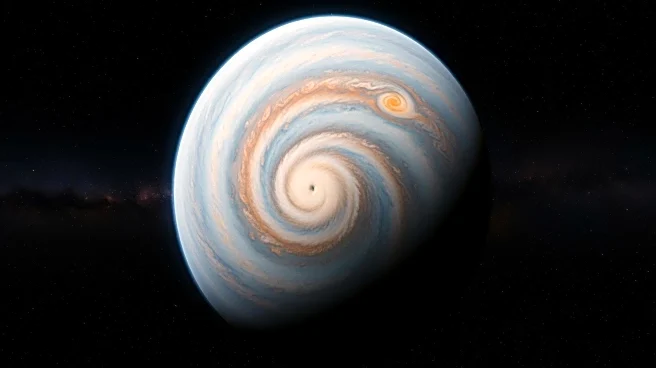
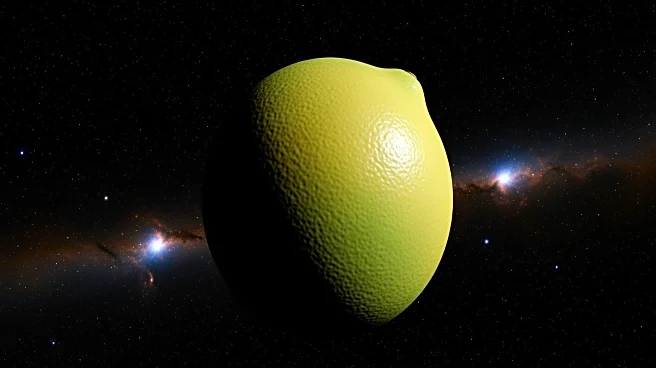
NASA's James Webb telescope has discovered a unique lemon-shaped exoplanet, PSR J2322-2650b, which is challenging existing theories about planetary formation and atmospheres. This exoplanet, found orbiting
a pulsar, is about the mass of Jupiter and is located just 1 million miles from its star, a distance that causes the star's gravity to distort the planet into a lemon shape. The exoplanet's atmosphere is unusual, dominated by helium and carbon, with clouds of carbon soot potentially forming diamond rain. This discovery raises questions about the planet's formation, as it lacks the typical molecules like water, methane, and carbon dioxide, instead showing molecular carbon such as C3 and C2. Some scientists theorize that PSR J2322-2650b might be the stripped remains of a former star, a hypothesis that aligns with its classification as a 'black widow system,' where a pulsar erodes its companion star.
Why It's Important?
The discovery of PSR J2322-2650b is significant as it challenges the current understanding of planetary formation and atmospheric composition. This exoplanet's unique characteristics could lead to new insights into the processes that govern the formation of planets and their atmospheres, particularly in extreme environments. The presence of carbon soot and potential diamond rain suggests complex chemical processes that are not yet fully understood. This finding could impact the study of exoplanets and the search for life beyond Earth, as it expands the range of possible planetary environments. Additionally, understanding such unique systems could provide clues about the lifecycle of stars and the formation of exotic planetary bodies.
What's Next?
Future research will likely focus on further analyzing the composition and formation of PSR J2322-2650b to understand its origins and the processes that led to its current state. Scientists may use additional observations from the James Webb telescope and other instruments to gather more data on the exoplanet's atmosphere and its interaction with the pulsar. This could involve studying similar 'black widow systems' to determine if PSR J2322-2650b is an anomaly or part of a broader class of celestial objects. The findings could also prompt a reevaluation of existing models of planetary formation and the conditions necessary for planet formation in extreme environments.
Beyond the Headlines
The discovery of PSR J2322-2650b highlights the complexity and diversity of planetary systems in the universe. It raises questions about the classification of celestial bodies and the criteria used to define planets and stars. The potential for diamond rain and the absence of typical atmospheric molecules challenge existing chemical models and suggest that there may be unknown processes at work. This discovery also underscores the importance of advanced telescopes like the James Webb in expanding our understanding of the universe and uncovering phenomena that were previously beyond our reach.