
What's Happening?
The International Space Station (ISS) crew is preparing for a spacewalk and the departure of a Japanese cargo craft. NASA flight engineers Chris Williams and Jack Hathaway, along with ESA Flight Engineer Sophie Adenot, are involved in readying spacesuits
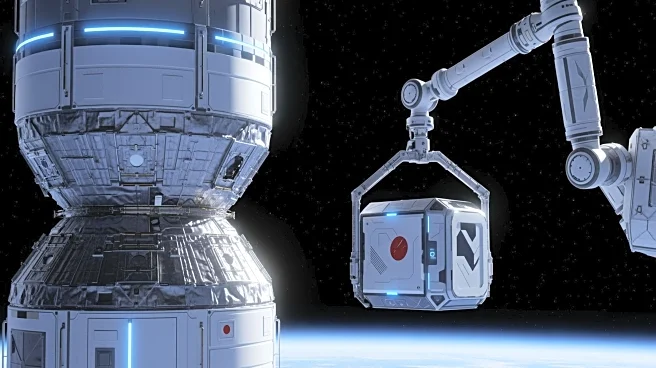
and studying procedures for the upcoming spacewalk. This spacewalk, postponed from January, aims to install a modification kit and route cables for a future solar array. Concurrently, the crew is packing the Japanese HTV-X1 cargo craft, which arrived in October 2025, for its departure. The HTV-X1, carrying over 12,000 pounds of science, supplies, and hardware, will be released into Earth orbit by the Canadarm2 robotic arm. It will conduct remote science activities for three months before reentering the Earth's atmosphere. The crew is also engaged in various research activities, including testing robotic arms and studying the effects of microgravity on human cognition and physiology.
Why It's Important?
The preparation for the spacewalk and the departure of the HTV-X1 cargo craft are significant for several reasons. The spacewalk will facilitate the installation of a solar array, enhancing the ISS's power capabilities. This is crucial for supporting ongoing and future scientific experiments and operations aboard the station. The HTV-X1's departure marks a critical step in managing the logistics and supply chain of the ISS, ensuring that the station remains well-stocked and operational. The research conducted during this period, including studies on microgravity's impact on human health and the testing of robotic technologies, contributes to the broader understanding of long-term human spaceflight. These activities are essential for future missions, including those planned for the Moon and Mars, as they provide valuable insights into the challenges and solutions for sustaining human life in space.
What's Next?
Following the spacewalk and the HTV-X1's departure, the ISS crew will continue with their scheduled scientific and maintenance activities. The spacewalk is expected to take place later this month, with live coverage available for public viewing. The HTV-X1 will conduct remote science activities for three months before its planned reentry. The data and experiences gained from these operations will inform future missions and technological developments. Additionally, the ongoing research on the ISS will continue to provide insights into the effects of space travel on human health and the potential for robotic automation in space operations.