
What's Happening?
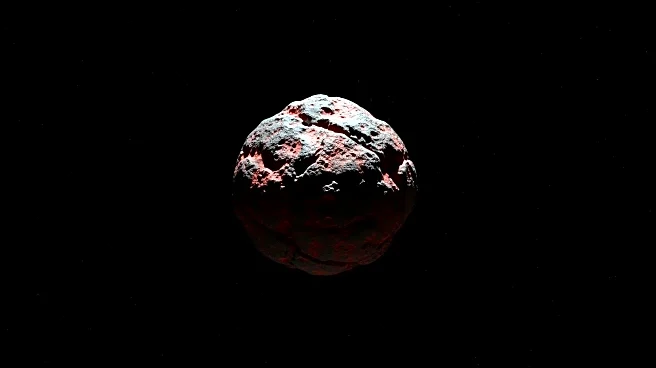
Recent observations using the James Webb Space Telescope (JWST) have provided the first infrared spectra of Uranus's small inner moons, revealing that their surfaces are much redder, darker, and more water-poor
compared to the larger moons. The research, to be presented at the 2025 AGU Annual Meeting, highlights the unique properties of these moons and their challenging observation due to their proximity to Uranus's bright surface. The study also discovered a new moon, temporarily named S/2025 U1, orbiting just outside Uranus's epsilon ring.
Why It's Important?
Understanding the composition and dynamics of Uranus's moons is crucial for comprehending the planet's history and the formation of its ring system. The differences in surface properties among the moons suggest varied origins and interactions, potentially offering insights into the chaotic past of Uranus. The findings also emphasize the importance of advanced telescopes like JWST in revealing details that were previously elusive, aiding in the study of planetary systems and their evolution.
What's Next?
Further observations with JWST are planned to continue exploring Uranus's moons and rings. Researchers aim to establish long-term monitoring to better understand the dynamics and possibly estimate the masses of these moons. The study of Uranus's system may lead to new discoveries about the planet's history and the interactions within its moons and rings, contributing to the broader understanding of planetary systems.