




What's Happening?
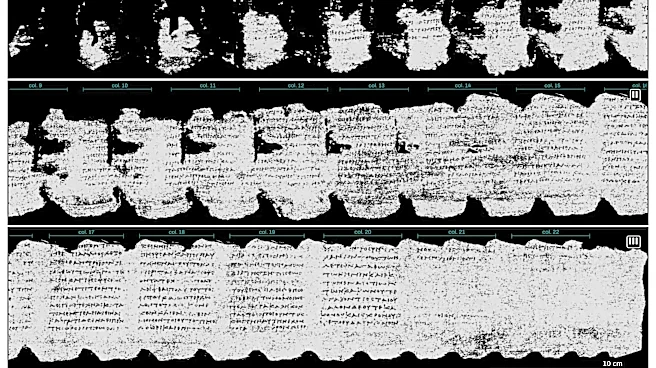
Researchers have successfully deciphered two ancient scrolls buried by the eruption of Mount Vesuvius nearly 2,000 years ago, using advanced imaging and artificial intelligence. The scrolls, part of the Herculaneum collection, were preserved in ash and have been
unreadable until now. The breakthrough was achieved through the Vesuvius Challenge, an international effort to digitally read these ancient texts. The deciphered scrolls include a Stoic treatise on ethics and human behavior, potentially linked to the philosopher Chrysippus. This discovery adds significant value to the historical understanding of early Stoic thought.
Why It's Important?
The successful reading of these scrolls represents a major advancement in the field of archaeology and ancient studies, showcasing the potential of technology in uncovering historical knowledge. The findings provide new insights into Stoic philosophy, which has influenced Western thought for centuries. This development highlights the intersection of technology and humanities, demonstrating how modern tools can unlock the secrets of the past. The deciphered texts could lead to a deeper understanding of ancient philosophical traditions and their impact on contemporary thought.
What's Next?
Researchers plan to continue examining other unopened scrolls in the Herculaneum collection, potentially revealing more historical texts. The use of AI and imaging technology in archaeology is likely to expand, offering new opportunities to explore and understand ancient civilizations. The findings may inspire further interdisciplinary collaborations between technologists and historians, aiming to preserve and interpret historical artifacts. Additionally, the discovery could lead to renewed interest in Stoic philosophy and its relevance to modern ethical discussions.