



What's Happening?
A new study from the University of Washington, published in npj Space Exploration, indicates that the north pole of Mars contains significantly less dust than scientists previously believed. While most of Mars' ice is buried beneath a dusty surface layer,
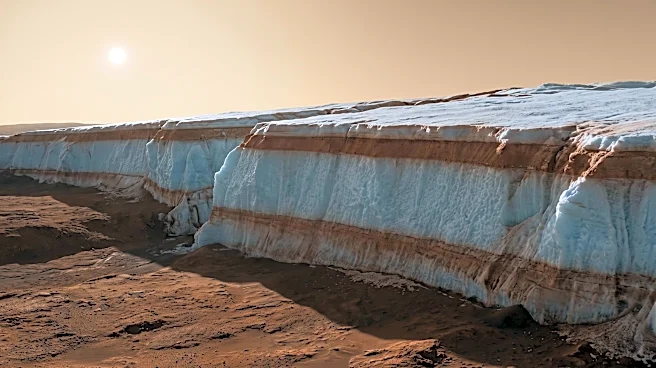
this research focused on the exposed ice at the north pole. Dust content is crucial because it affects how much sunlight ice reflects, influencing its temperature and vaporization rate. Earlier estimates suggested that the top layer of polar ice contained as much as 25% dust by mass; however, this study revises that figure to approximately 3%. The researchers, including senior research scientist Aditya Khuller and recent geoscience graduate Pari Mohan, utilized data from the Mars Phoenix mission and observations from orbiting satellites. They adapted Earth-tested methods for analyzing snow and ice, developed by UW professor emeritus Steve Warren, to re-evaluate the Martian ice composition. The findings suggest that the north pole is structured in layers, resembling an 'ice cream sandwich,' with cleaner ice beneath seasonal, dustier frost.
Why It's Important?
This discovery significantly impacts our understanding of Mars' past climate and its potential for hosting life. The lower dust content means the ice is brighter and reflects more sunlight, leading to slower vaporization. This could imply that larger quantities of water ice have been preserved over longer periods than previously assumed, offering a more stable environment for potential past or present microbial life. Ice on Mars, much like on Earth, contains valuable records of past climate, and a clearer understanding of its composition allows scientists to more accurately reconstruct Martian climate history. Furthermore, the presence of cleaner ice layers could influence future missions to Mars, particularly those focused on resource utilization or the search for biosignatures. The study also highlights the importance of refining analytical methods, demonstrating how Earth-based techniques can be successfully adapted to extraterrestrial environments, thereby improving the accuracy of planetary science research and guiding future explorations.
What's Next?
The researchers plan to expand on this work by applying their improved analytical methods to other regions of Mars, aiming to gain a more comprehensive understanding of the planet's ice distribution and composition. Future missions to Mars may incorporate these revised dust content estimates into their planning, particularly for landing sites or areas of interest for scientific investigation. The findings could also prompt further research into the formation and evolution of Martian ice layers, potentially leading to new insights into the planet's geological and atmospheric history. The concept of 'ice cream sandwich' layering, with cleaner ice beneath seasonal frost, will likely be a focus for further study, as it provides critical clues about the planet's climate cycles. Continued investigation into the potential for meltwater pockets within dusty ice, as suggested by Khuller in previous work, will also be important for assessing the habitability of Mars.
Beyond the Headlines
The revelation of cleaner ice at Mars' north pole has profound implications for the ongoing quest to understand whether life ever existed, or could exist, on the red planet. The presence of less dusty, and thus potentially more stable, water ice increases the likelihood of finding preserved organic molecules or even dormant microbial life. This finding also underscores the dynamic nature of planetary environments, where even seemingly barren landscapes can hold complex geological and climatic histories. The comparison to Earth's ice records emphasizes the universal principles governing ice formation and preservation, while also highlighting the unique challenges of studying extraterrestrial ice. The question of 'Why does one planet have life and the other doesn't?' becomes even more compelling with these new insights, pushing scientists to explore subtle differences in environmental conditions that could tip the balance towards habitability. This research contributes to a broader scientific narrative that continually refines our understanding of planetary habitability and the potential for life beyond Earth.