






What's Happening?
Taiwan's coast guard has accused China of harassing its vessels and attempting to assert 'fictional jurisdiction' in the South China Sea and waters east of the island. This accusation follows an incident where a Chinese coast guard vessel entered restricted
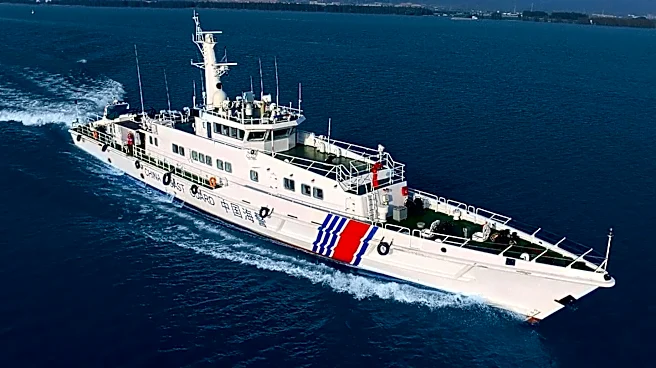
waters near the Pratas Islands, a Taiwan-administered coral island, leading to a confrontation where the two vessels came within one nautical mile of each other. Taiwan's coast guard reported this as the 13th Chinese intrusion near the Pratas Islands this year, involving 16 vessels, and urged Beijing to cease these 'pointless acts of harassment.' Separately, China announced a 'routine law enforcement patrol' by two of its coast guard vessels in waters east of Taiwan, prompting Taipei to send its own vessels to monitor them. Taiwan alleges that China used radio communications to harass ships and expand its presence, violating international law and undermining regional peace.
Why It's Important?
This escalation of tensions in the South China Sea and around Taiwan carries significant geopolitical implications for the U.S. and its allies. The Pratas Islands are strategically located, and China's repeated intrusions are perceived by Taiwan as part of a broader strategy to assert control and potentially prepare for a maritime blockade. Such actions challenge the existing international maritime order and raise concerns about the security of vital shipping lanes. For the U.S., which maintains strong unofficial ties with Taiwan and advocates for freedom of navigation, these incidents underscore the growing instability in the Indo-Pacific. The potential for miscalculation or accidental conflict increases with heightened naval activity, which could draw in regional and international powers, impacting global trade, supply chains, and diplomatic relations. The U.S. has consistently expressed concerns over China's military and maritime activities in the region, viewing them as destabilizing.
What's Next?
The situation is likely to remain volatile, with both sides continuing to assert their claims and conduct patrols. Taiwan will likely continue to monitor and challenge Chinese incursions, while seeking international support to deter further aggression. China is expected to maintain its increased naval presence and 'law enforcement patrols' as part of its strategy to normalize its claims over disputed waters. The international community, particularly the U.S. and its allies, will continue to express concerns and potentially increase their own naval presence or conduct joint exercises in the region to uphold freedom of navigation. The possibility of further confrontations, either accidental or intentional, remains high, necessitating careful diplomatic engagement to prevent escalation. The long-term trajectory points towards sustained geopolitical competition and potential shifts in regional power dynamics.
Beyond the Headlines
The ongoing harassment by China's coast guard vessels against Taiwan's maritime assets reflects a broader strategy of 'gray zone' tactics, which involve actions below the threshold of armed conflict but designed to assert sovereignty and gradually alter the status quo. This approach allows China to test the resolve of Taiwan and its international partners without triggering a direct military confrontation. The accusations of 'fictional jurisdiction' highlight the fundamental disagreement over territorial claims and international law in the South China Sea. This situation also has significant implications for the principle of self-determination and the sovereignty of smaller nations in the face of a rising power. The international community's response to these 'gray zone' tactics will set precedents for how similar disputes are handled globally, potentially influencing the stability of other contested regions and the future of international maritime law.